
Mattie our Trainee reflects on their year spent gardening here at Beth Chatto's Plants & Gardens.
How summer heat has affected the plants
POSTED 14th August 2026

We are now over 60 days since any substantial rainfall, plus consistently high temperatures and typically cloudless skies. Time to check in on what’s doing well and what’s not in our garden.
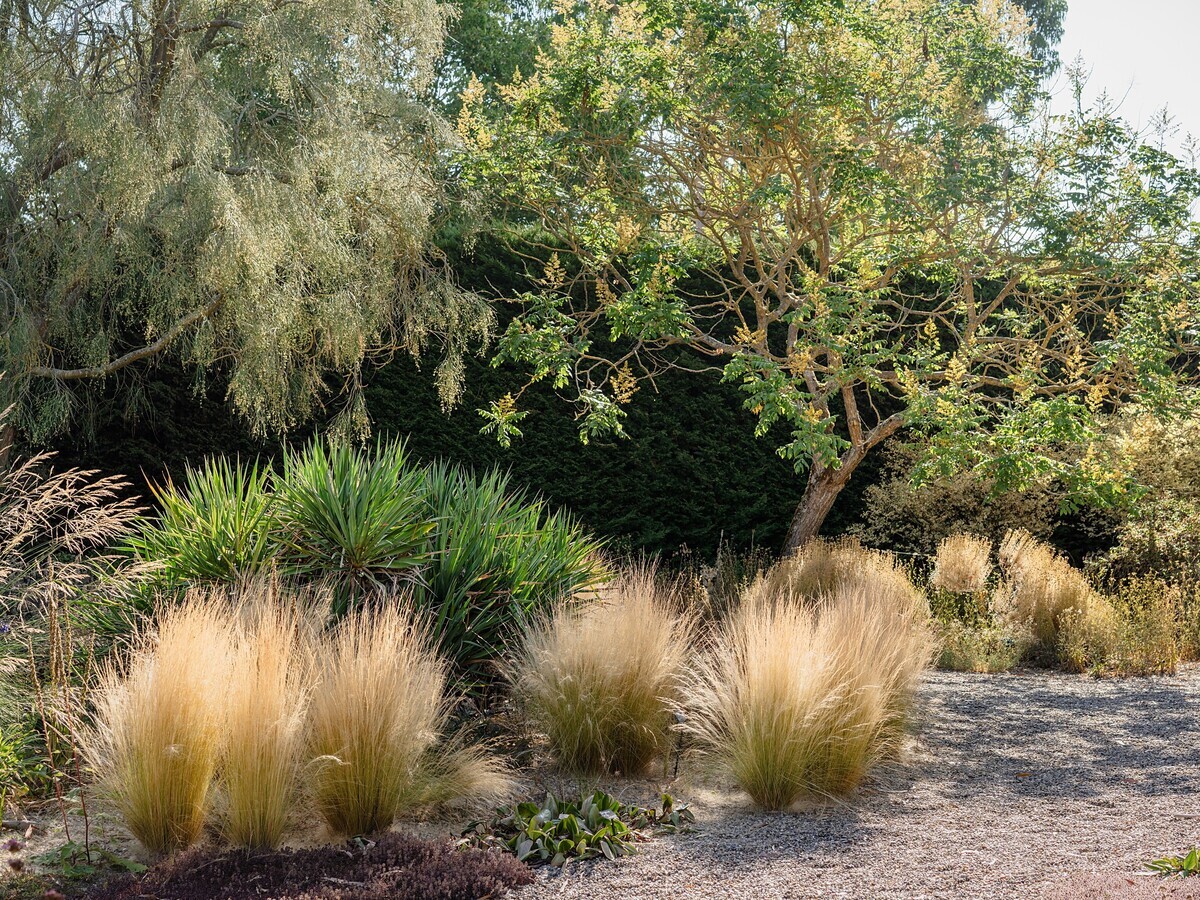
With the foresight of Beth, the Gravel Garden is best placed to cope with this trying weather. There is still good colour throughout, contrasting forms, but some plants are very much shorter than previous years and some have already entered an autumnal phase.
Let’s start with what’s looking good
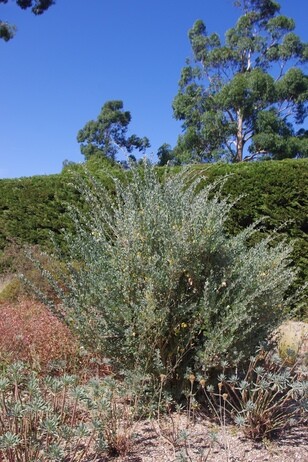
Two plants with silvery or white foliage, both holding up exceptionally well are Atriplex halimus and Epilobium canum ‘Olbrich Silver’. The tree purslane (atriplex) has already had a prune this year, but despite the conditions, new growth is vigorous. The silver leaves protect the plant by reflecting heat. The white foliage of ‘Olbrich Silver’ has a similar effect, but the leaves are also narrow, reducing water loss.
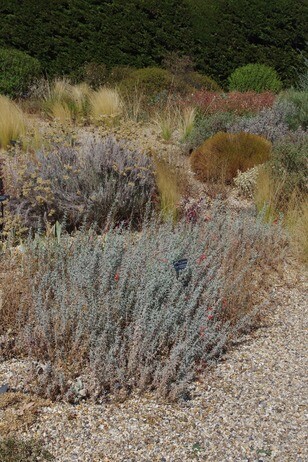
Epilobium canum ‘Olbrich Silver’
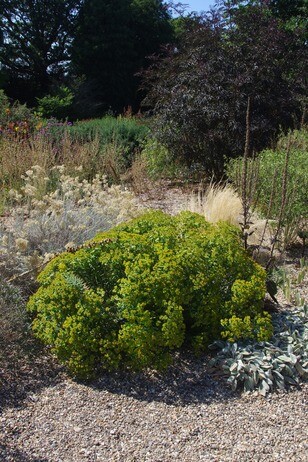
At the other end of the Gravel Garden Euphorbia ‘Abbey Dore’ has been in flower since June and the spent flower heads are providing a protective dome, keeping the air cooler around the base of the plant.
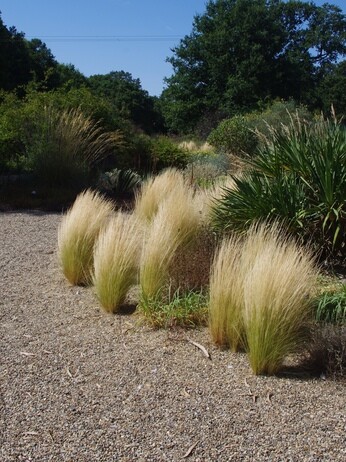
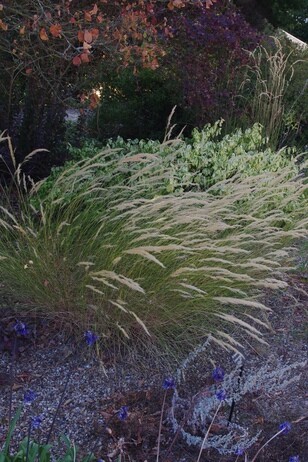
With their narrow foliage grasses are perfect for this spell of hot and dry weather. Stipa tenuissima has morphed into its pale straw coloured foliage, upright, but gently buffeted by the warm breeze. Stipa calamagrostis can take more shade and with the dry soil it’s kept it more compact, foliage arching, showing off the feathery panicles, which should last through much of the year.
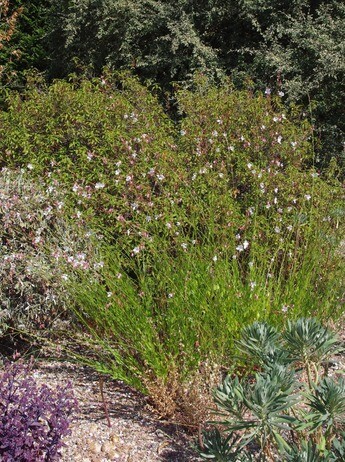
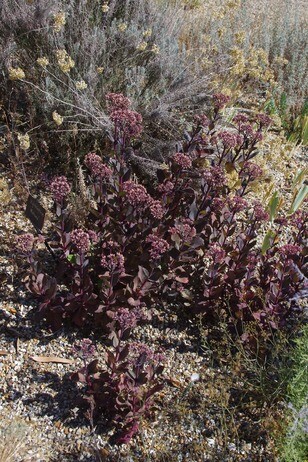
A couple of good do-ers, which a good dry garden shouldn’t be without, gaura, Oenothera lindheimeri and sedum, Hylotelephium ‘Matrona’, are unaffected.
Plant combinations in the Gravel Garden
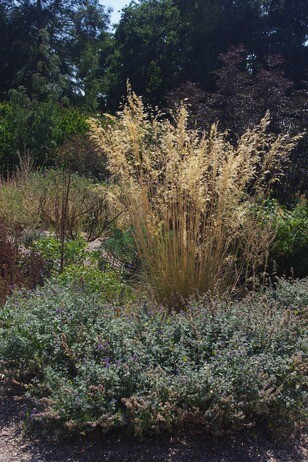
Stipa gigantea, the golden oat grass, always a star in dry conditions. Benefiting from the calm conditions, the tall stems are remaining upright, each oat-like flower backlit by the hot sun. Surrounded at its base by Nepeta ‘Hill Grounds’, a lower, tough catmint, already into its second flowering of the year.
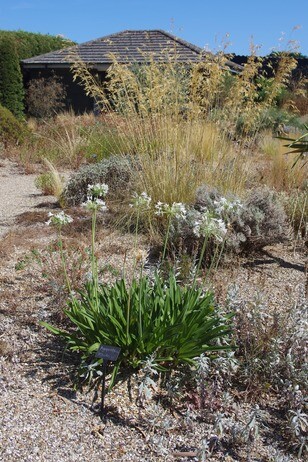
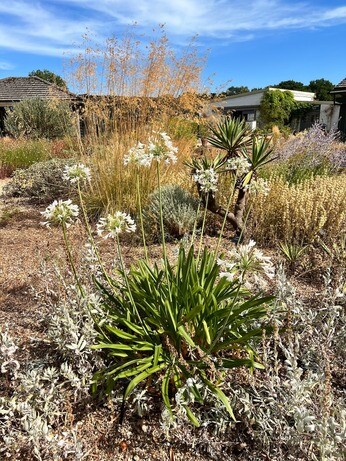
Agapanthus have thickened, fleshy roots, excellent for water storage and when established they can make very congested clumps, providing a mass of foliage which can reduce heat reaching the crown of the plant. ‘Albatross’ is flowering and holding on, but at 1/3rd of previous years flowering height.
Not so good
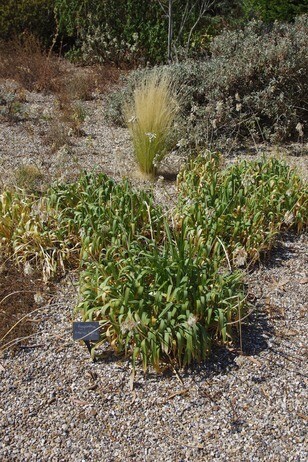
This is where the not so good make an appearance. Just across from ‘Albatross’, in the same soil, the same situation, light levels, is 'Ardernei Hybrid'. Stunted flowering, leaves curling. Time for a refresh of these clumps.
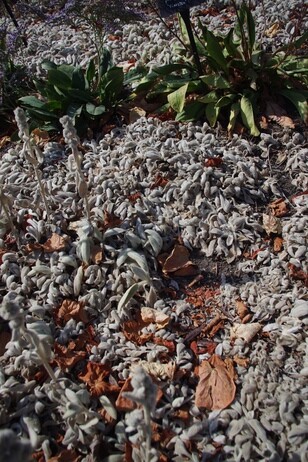
It’s not alone in struggling, Bergenia ‘Beethoven’, Origanum sp., Hypericum olympicum, Stachys byzantina all feeling the effects of a lack of water, but also the high light levels. We’ll leave the foliage alone, as it provides a little protection for the plants, corralling what small amount of water there is available (at least there is some early morning dew currently).
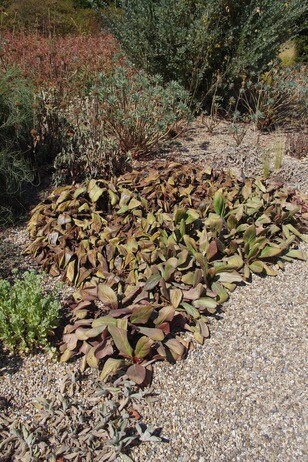
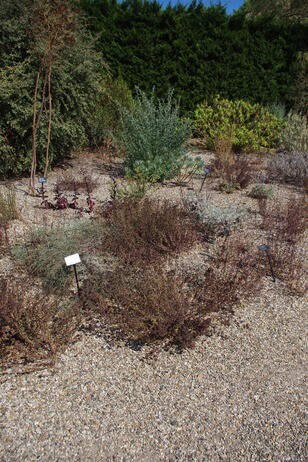
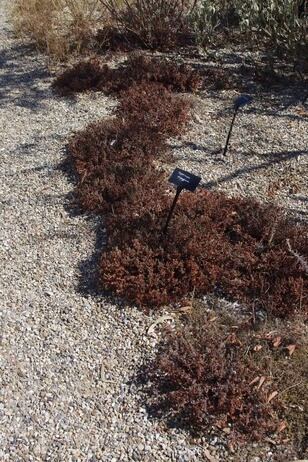
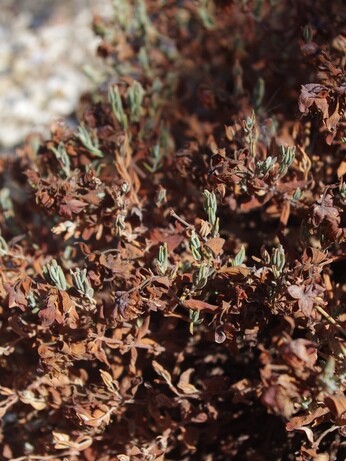
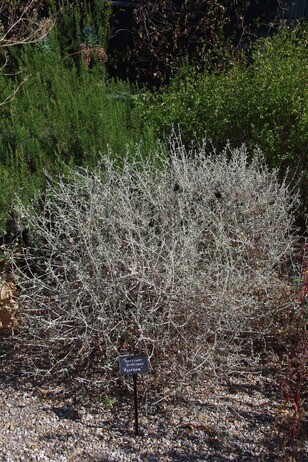
Lastly from the Gravel Garden, a selection of Mediterranean shrubs, all with reducing foliage during this high summer heat. Although our UK temperate maritime climate is similar to a Mediterranean climate, our rainfall typically spans much of the year, whereas in the Mediterranean it’s concentrated over October to March. Plants from that region tend to grow during this period and have developed summer dormancy to cope with the conditions. Once the weather cools and we have rain, we’d expect our shrubs to produce additional foliage.
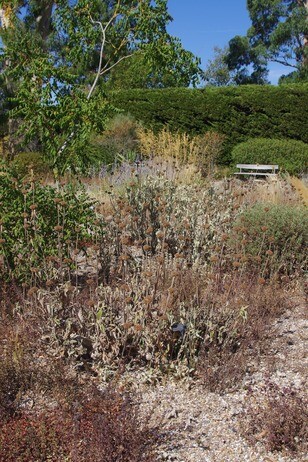
Although conditions in the Gravel Garden are tough, it does have hedge and tree protection from wind and there are reasonable amounts of shade. The Reservoir Garden on the other hand can be a much tougher environment, with wind coursing across the whole area and little shade.
With this in mind we are trialing new plants in this area and adding in more plants of those that are doing well.
The Reservoir Garden
The upright form of Calamagrostis x acutiflora ‘Karl Foerster’ has bleached a little earlier than normal, but its still standing tall and should last well into winter. Interestingly, below it still green-leaved, is Amsonia ‘Blue Ice’. Diminutive in size, but seemingly tough in nature. A good number of garden worthy amsonias hail from the hotter and humid SE USA, giving them an ability to cope with this extraordinary summer.
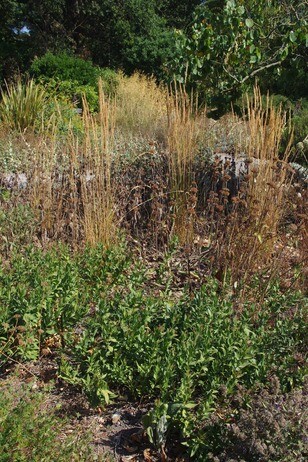
Calamagrostis x acutiflora ‘Karl Foerster’
At the top of the Reservoir Garden, Cephalaria balansae has seeded around almost creating its own micro-climate. In amongst it is the recognisable form of Miscanthus sinensis ‘Morning Light’. Most other miscanthus haven’t enjoyed this area of the garden, in all likelihood a little too dry for them, but ‘Morning Light’, with its narrower foliage, white effect, all very tightly packed, is protecting it in this harsh environment.
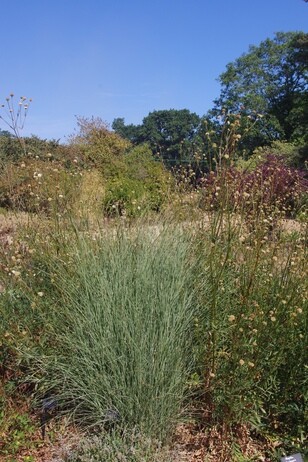
Miscanthus sinensis ‘Morning Light’
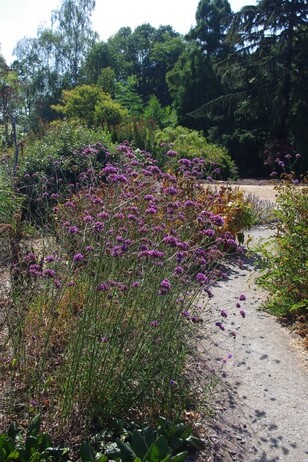
A couple of excellent performers, Verbena bonariensis and Glycyrrhiza yunnanensis. The well-known verbena has tough and narrow leaves, reducing water loss, plus grows naturally in much of sub-tropical South America! The glycyrrhiza, (a liquorice relative), can shed much foliage in these hot summers, but its long tap-root allows it to reach water other perennials cannot and provides an energy store to help restart growth when appropriate.
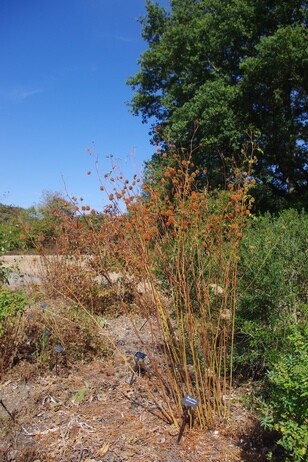
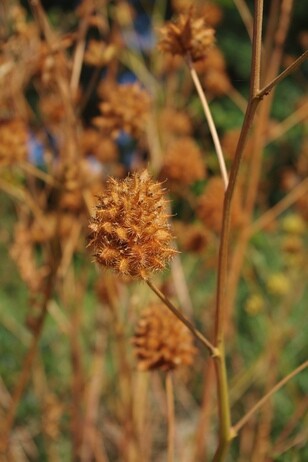
On the downside one established and typically reliable performer is struggling. Phlomis russeliana, the Turkish sage, has finished flowering as normal, its stems are upright, the whorled seed heads are forming, but we’d normally expect some soft, heart-shaped green foliage around the base. Not this year. There is enough material carpeting the ground, protecting the roots and crown, but we will have to wait and see how quickly this reliable perennial greens up in the autumn.
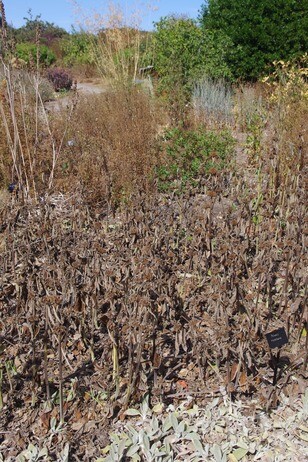
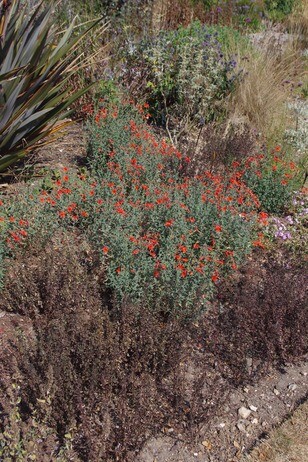
With the Turkish sage being long established and still suffering, new plants can be particularly vulnerable. On the lower corner of the Reservoir Garden Epilobium canum ‘Ed Carman’ is coping admirably, Origanum laevigatum 'Herrenhausen', as in the Gravel Garden has finished earlier than normal. Both are providing reasonable ground coverage.
A little further along, some new plants gave fared poorly, Symphyotrichum ericoides ‘Esther’ hasn’t been able to establish, the verbascums behind have finished and irises in front have been replanted (these will be fine), but it leaves a lot of bare soil, which heats up quickly, dries out quickly, causing the plants more stress. A negative feedback loop. Groundcover, mulches (put on the ground before the heat builds up), will help keep the ground cooler, retain more moisture and give the plants a chance to establish.
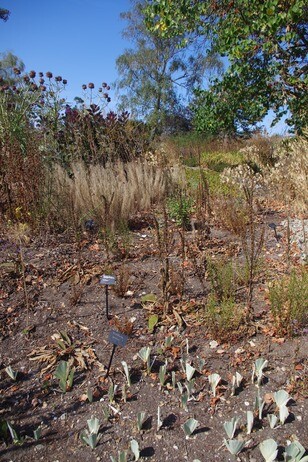
Symphyotrichum ericoides ‘Esther’
The Water Garden
Briefly popping down into the Water Garden, where there is more shade, more moisture, this snapshot of one of the Shade Beds shows a towering eutrochium (eupatorium) its foliage suffering from a little heat stress, but below that Lythrum virgatum 'Swirl', Bistorta amplexicaulis 'Rosea' and Lythrum salicaria, flowering and unaffected, below that Iris sibirica and Amsonia orientalis equally happy. The odd one out is a browned, scorched astilbe (on the right-hand side of the photo). Seemingly most of our astilbes have lost their foliage in this manner, in part due to water stress, but also more through the high sunlight/uv levels. This should be temporary!
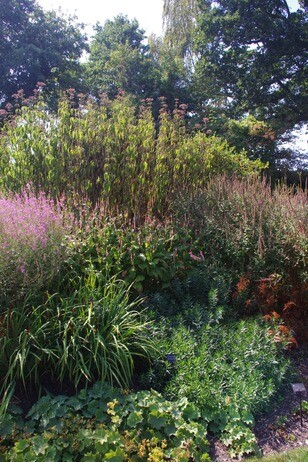
To finish on a positive, Miscanthus sinensis 'Beth Chatto', Solidago rugosa 'Loydser Crown' and Macleaya microcarpa 'Spetchley Ruby' all looking fabulous in our Water Garden.
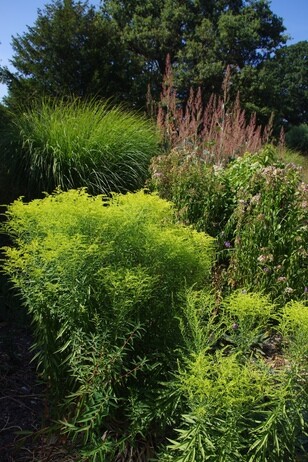
After the hot and dry summer of 2022 we had two of the wettest years for decades. Now we are experiencing this extraordinary year (well it is at the moment, although in the future this may be the norm). The resilience of plants is quite remarkable and we are all looking forward to some cooler and wetter weather. The response that brings will be very interesting. Check back in the autumn, hopefully for another, but greener blog.

Head of Horticulture Steve
Best wishes for the future.
However it's great to know that many plants will recover and thank you for the regular updates on your beautiful garden, which I rarely get the chance to visit now.
Here, just north of Oxford, the story is much the same but with agapanthus doing much better in pots than in the ground as they get watered occasionally. We have a hosepipe ban, so the latter is down mostly to cans of ‘grey’ water. My watered, large container-grown Origanum ‘Herrenhausen’ is still flowering but in our community orchard pollinator border, the latter has dried up, as has O. ‘Rosenkuppel’, another bee magnet. However, Echinops has been starring in both places and I will definitely get some more, as is Aster x frikartii ‘Monch’ and Salvias ‘Royal Bumble’ and ‘Nachtvlinder’. I’ve just had to start dousing 3 large Aster ‘Betel Nut’, which I think I got from you, as they are wilting just as they’re coming into flower. Calamagrosta ‘Karl Forster’ is providing golden structure but Panicum ‘Heavy metal’, always a late flowerer, has yet to show any sign of doing so. Last year the flowers on this were much shorter due to that drought but they remained upright all winter as a result. Early flowering Seslaria ‘nitida’ adds grey structure, as do Euphorbia wulfenii, rosemary and Lavender ‘Phenomenal’, which I have in low hedges bordering a path. The latter has long flower spikes, which I’ve now trimmed so it gives a structured edge to loose planting.
Win some/lose some but I’m hoping the latter will offer a replacement challenge and have already used birthday tokens to buy late flowering Allium ‘lavender bubbles’ and A. ‘Millenium’, recently seen enmasse and smothered in bees at a Piet Oudolf designed garden.
Thank you and can’t wait for the follow ups!