
Find out what the propagation and garden teams have been up to this week.
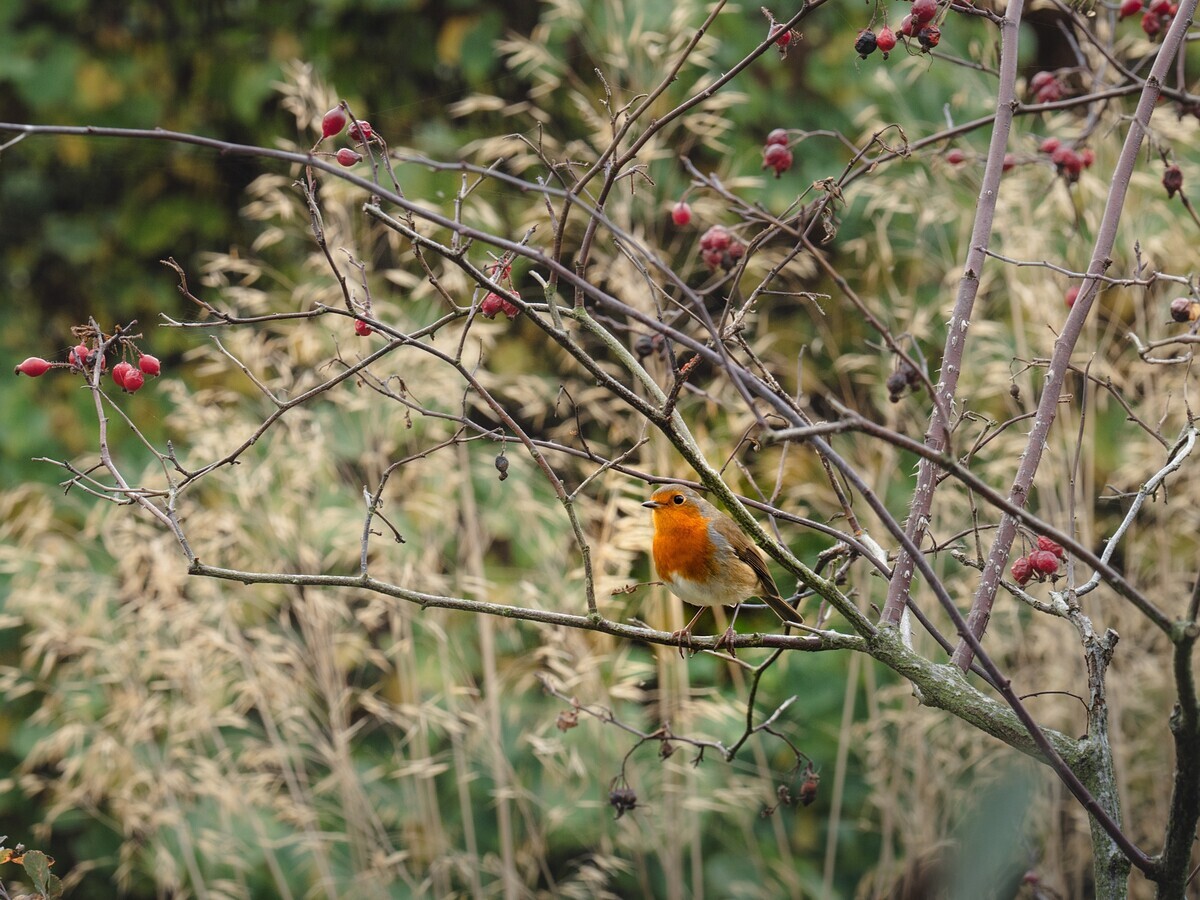
Wild Words from the Ground - October
POSTED 2nd November 2026

Welcome to our blogs featuring the photos and sightings of wildlife in the garden (and outreach sites like Chattowood, and the Meanwhile Garden and Albert Roundabout in Colchester) by our staff, whether in the office, shop, tea-room, nursery or garden. The images are curated and commented upon by Dr Chris Gibson, our Wildlife Advocate.
While the photos are not always of the highest quality – our staff are busy doing their main jobs! – they give a real feel of life in the garden, something we are very keen to encourage, as indeed was Beth.
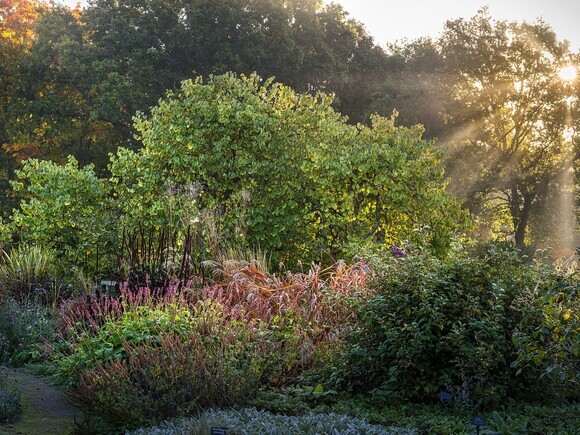
October has been a typical mixed bag. There has at least been some much-needed significant rain, interspersed with warm, still days, but also a couple of named storms, rushing through and ushering in autumn. And the garden looks just lovely in its russet splendour! The re-greening of the Gravel Garden especially has been a delight to see after the crispiness of summer.
And so now autumn is here, our thoughts turn to recycling the growth of the year so far. And of course much of this work is done for us by fungi, many of which put on their greatest show at this season. After the warmth of the summer and the return of the rain, I have been expecting a bumper crop, but that has yet to materialize, proof as if it were needed that the natural world has a mind of its own!
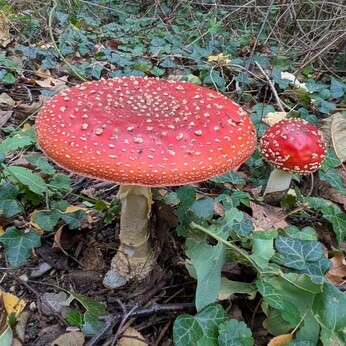
Always a favourite (to look at) is Fly Agaric, the unmistakeable, archetypal toadstool usually to be seen with a gnome astride it in the half-light of autumn… And Scott captured this beautiful image in the spot it usually appears at the end of the Memorial Garden. Here there are the Silver Birches, with the roots of which the fungus is normally associated.
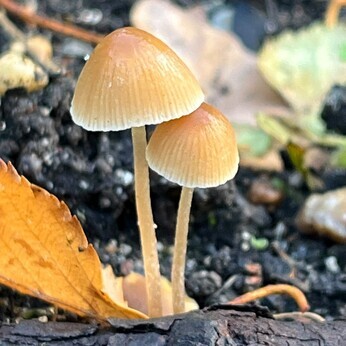
But not all fungi are so instantly recognisable. There are lots of brownish ones for which microscopic examination of the spores is often one of the crucial steps towards definitive identification. Scott again photographed one such which may be the Willow Shield Pluteus salicinus…
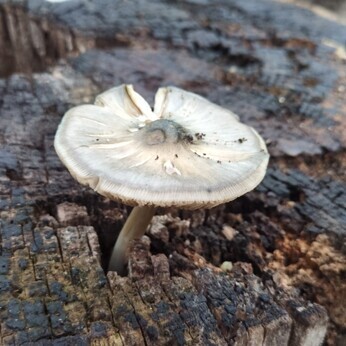
…while Cathy’s specimen is likely to be a Psathyrella species.
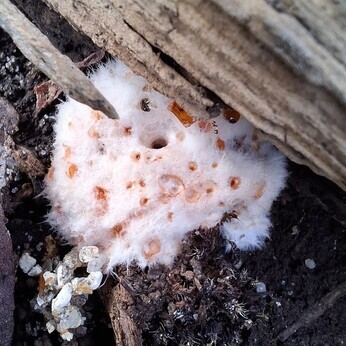
Of course, the fruiting bodies of macrofungi are only the tip of the iceberg. There is a lot more going on in the soil or dead wood, with the fungal mycelium hunting out nutrients over large areas. Indeed, some fungi are known only from their mycelial stages, never forming the fruiting bodies, and naturally these are difficult or impossible to identify for sure unless you have access to a DNA sampling and testing kit. No exaggeration here: such is the unpredictability of fungal fruiting in grassland for example that the most effective way of surveying such species is by sequencing the DNA found in soil samples.
Jess provided this instructive photo of a fungal mycelium, the business end of a fungus that does all the rotting. All mycelium looks much the same but this is doing something interesting, producing droplets of coloured liquid, a phenomenon known as guttation. Some fungal fruiting bodies, especially brackets, do this too. Guttation seems to be associated with stages of rapid growth in the life cycle of fungi, so it is believed that during rapid growth periods excess water produced by accelerated respiration is exuded as often coloured droplets. Guttation is also a phenomenon shown by some plants, but that’s another story for another day!
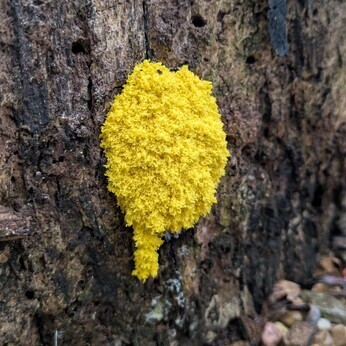
When is a fungus not a fungus? When it is a slime mould. Long classified with the fungi, slime moulds now occupy their own kingdom of life, possibly most closely associated with the bacteria. They are single-celled organisms that live free in the soil or the substrate they occupy, such as dead wood. But sometimes, environmental cues align, and the cells start to swarm together to form a reproductive mass, as in this spectacular Fuligo septica from Scott. Then three or four days later the whole lot melted back into the anonymity of the microscopic world.
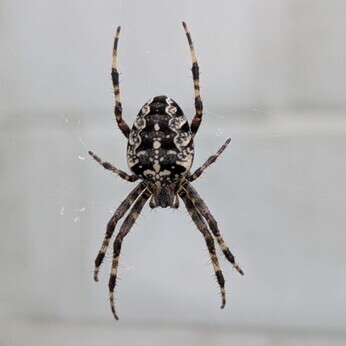
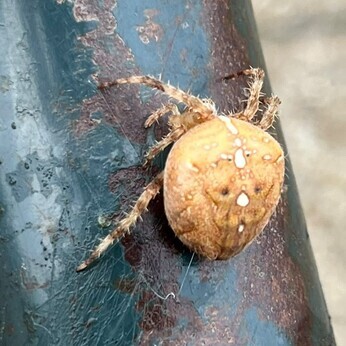
Regular readers of these blogs will realise that we cannot always put a name to everything we find. This might be because it is very tiny, or because difference between species are so small. Or because some species are so variable they may not look like the same thing at all. The two photos below, from Scott and Cathy respectively, might look quite different, but they are actually the same species, the Garden Cross Spider. Both have a vaguely cross-shaped array of white spots but there the similarities end.
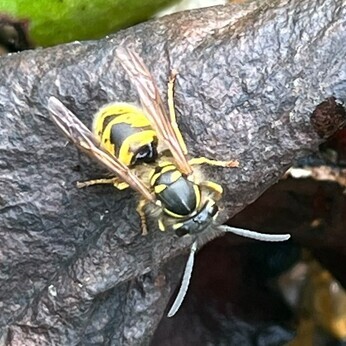
Spiders are often larger and more noticeable at this time of year than any other. The same can be true of social wasps. At the start of winter, all wasps have died apart from the founding queens of next year’s nests. So from the end of November all we are likely to see are those large queens, and they are likely to be pretty sluggish, or ‘sleepy’ as Cathy described this Common Wasp, because of the cooler temperatures.
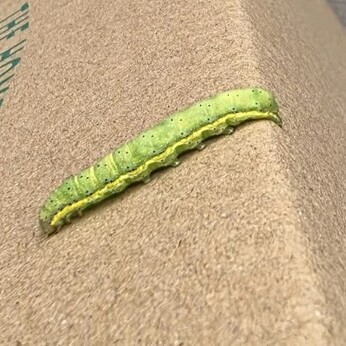
The early stages of moths can be quite obvious at this season, whether it is Pete’s Bright-line Brown-eye caterpillar …
…or Rob’s mass of Vapourer Moth eggs, which were laid on the cocoon from which the female emerged: she is flightless, and her adult existence consists of emergence, mating, egg laying and death, all the space of a few centimetres.
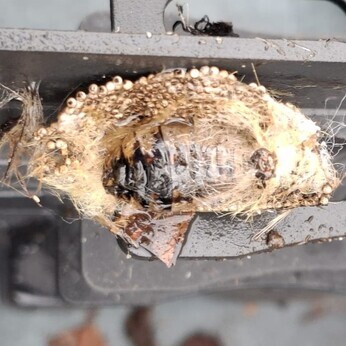
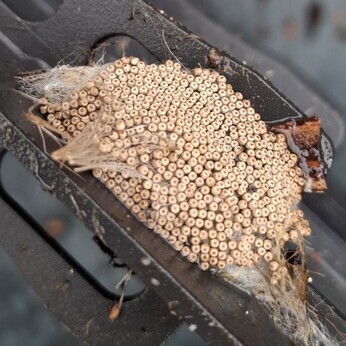
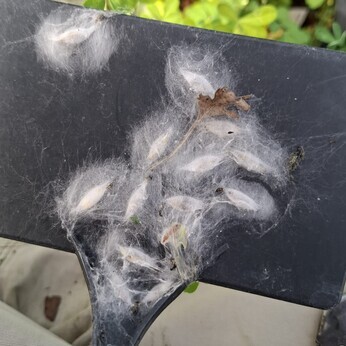
But sometimes, again, there is simply not enough information to say what everything is. Rob’s photo shows a series of webby/coccoony things, which could be either something to do with a spider or a lepidopteran, these being the two main silk-spinning invertebrate groups. These look nothing like spider egg-sacs I have seen so I am erring towards a moth, and just possibly the cocoons of a small ermine moth, of which there are several species, all gregarious.
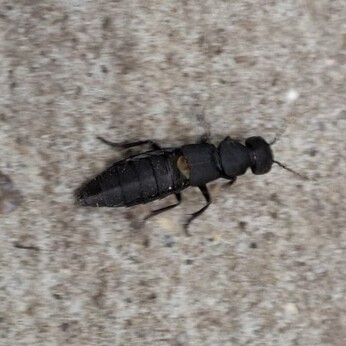
There are many kinds of beetle, some long-lived, in every possible terrestrial ecological niche, so not surprisingly, adult beetles may be found in the garden year-round. This month, Rob photographed a Devil’s Coach-horse, the largest of the rove-beetles…
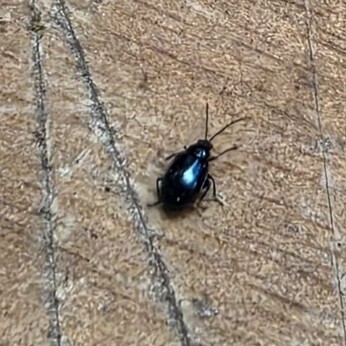
… while Richard found, at the other end of the size scale, a small, shiny, purplish flea-beetle of the genus Altica. But there are squillions of species and all look identical unless you examine them under a microscope. Not something I would do, because you have to kill them first...
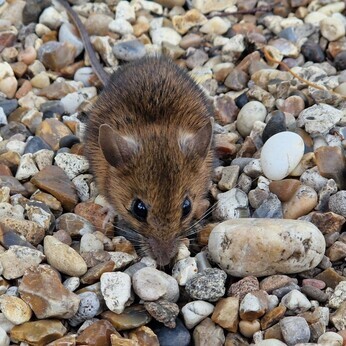
While we have a huge list of creatures found in the garden, there are still many that we haven’t got on the list simply because we haven’t looked closely for them. Small mammals are a case in point: we haven’t spent time catching them for identification purposes, so Matt’s Wood Mouse represented our first record of that species, even though it certainly always present.
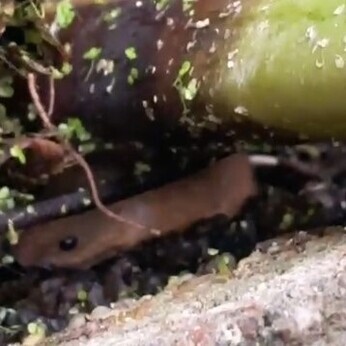
This month saw the team undertaking a major task, clearing silt and excessive plant growth from the margins of the ponds. While doing this, Ned spotted another small mammal hiding within the tangled growth. His video didn’t show sufficient detail for definitive identification, but its reddish colour and snub nose suggests this is likely to be a Bank Vole, a species we have occasionally recorded in the past from dead specimens.
One day it would be good to carry out some small mammal trapping to see exactly what our garden supports. The same is true of fish, and it was good to hear that Eels were also found during the desilting works, something that we have not seen here for many years. It is always good to know that nature carries on, whether or not we see it!
The year is drawing to a close, and from now on it is possible these blogs will become less than monthly – the fingers that so willingly take photos around the garden in summer are sometimes more reluctant when it is cold! But who knows? Frosts are getting much less regular and severe in our worryingly warming world, and even in a ‘normal’ winter we could expect to see the last few butterflies and dragonflies persisting until the start of December. And before we know it, the solstice will be behind us and light and life will be returning!
For a different perspective on this month’s wildlife, have a look at my personal blog:
The Wild Side of Beth Chatto Gardens: Autumn advances … | Chris Gibson Wildlife
Indeed, you could look back at the whole archive of my blogs of Beth Chatto Gardens, going right back to 2018, all listed on the page Beth Chatto Gardens – activities, events and blogs | Chris Gibson Wildlife
COMMENTS