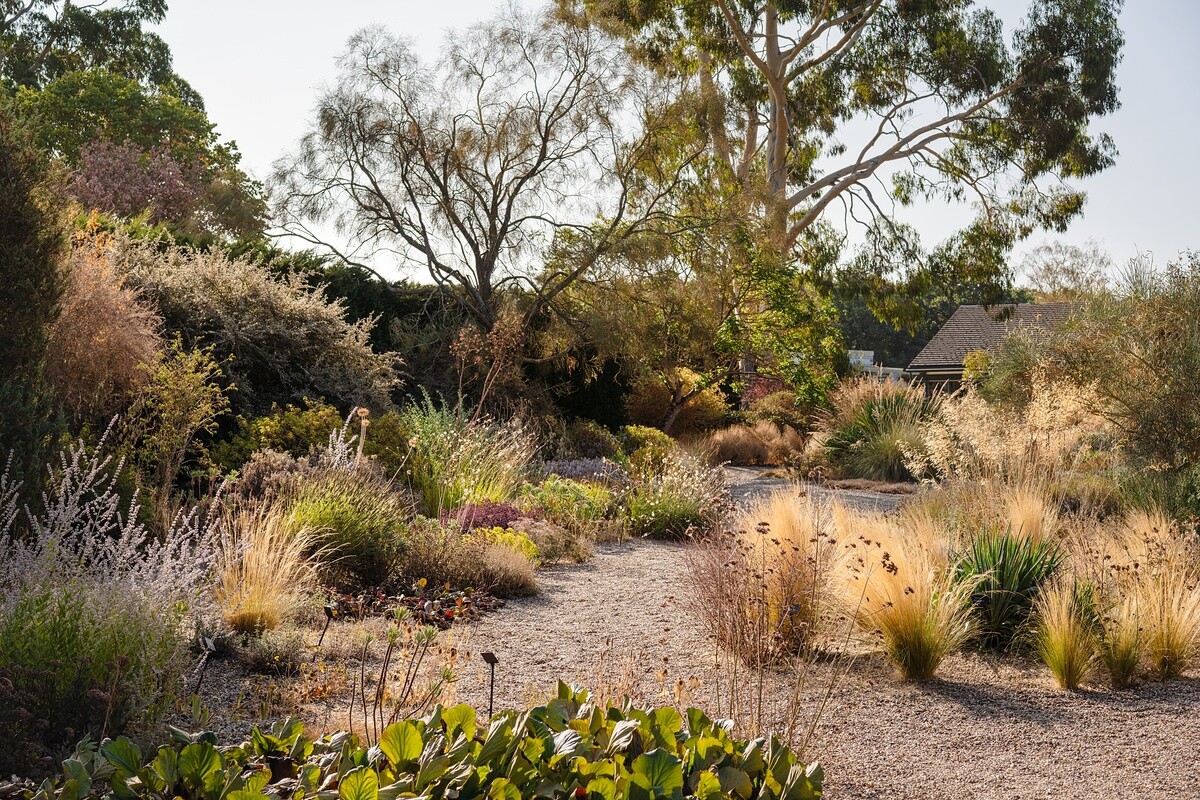
This summer has certainly put plants to the test. Long periods of heat, very little rain and one heatwave following another have made for challenging conditions, particularly on our lighter, free-draining soils. Yet, as ever, there have been plenty of plants that have not only survived but continued to look remarkably good.
Some have flowered for months, others have held onto good foliage despite the heat and dryness, while a few have surprised us by producing a second flush of flowers after being cut back. It is always interesting to see which plants really earn their place in the garden when conditions become challenging.
Now, as we head towards the end of September, with daytime temperatures still reaching above 20ºC, we have been reflecting on the summer and revisiting our list of plants that have coped particularly well.
These are some of the plants that have stood out this summer, bringing colour, texture, and good foliage to the garden, with many continuing to give plenty of interest well into autumn.
There are of course so many more wonderfully tough plants out there, that took a beating from the summer heat, but are now bouncing back again.
As always, when choosing plants, it is important to consider your local climate, aspect and soil type.
The stars of the summer
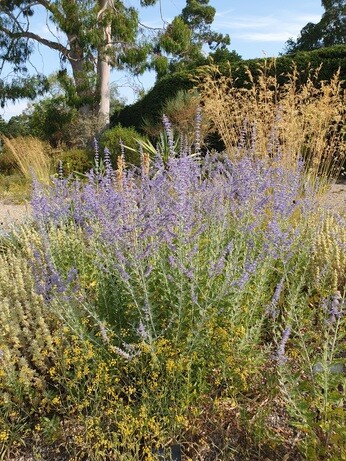
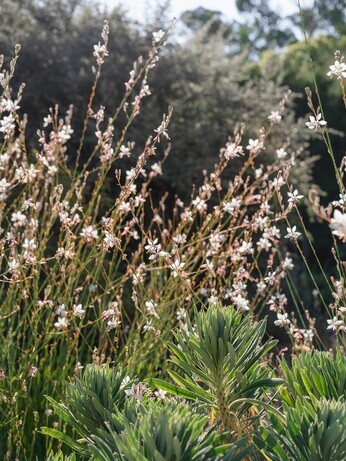
The two plants that have been particularly outstanding this summer – seemingly completely unperturbed by the heat and drought – are Salvia ‘Blue Spire’ (syn. perovskia) and Oenothera lindheimeri (syn. gaura). Both have flowered for months on end and have barely seemed to notice the challenging conditions.
Oenothera lindheimeri is still continuing to produce a cloud of delicate white blooms, floating above the foliage on wiry stem like little white butterflies. Nearby, the slender spires of Russian sage still hold a hint of blue, its upright stems bringing vertical structure and interest to the border through autumn and winter.
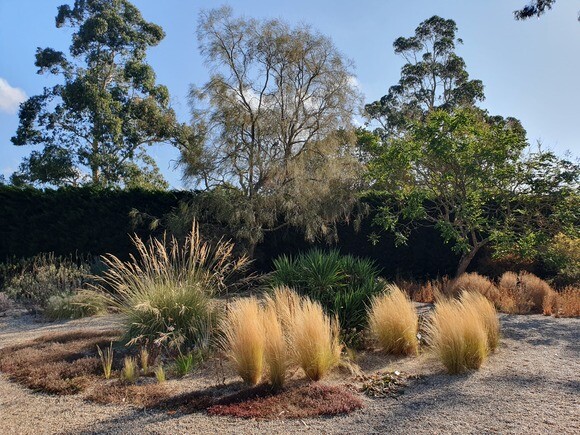
Ornamental grasses play an integral part in drought tolerant planting designs, bringing texture, movement and structure to the garden. When flowers become scarce in a heatwave, grasses offer a different kind of beauty, their gentle movement continuing to give the planting life and interest.
Stipa tenuissima thrives best in poor, sharp-draining soils where they stay more compact and upright. If the soil is too rich it has a tendency to become floppy and messy.
Airy plants for dry borders
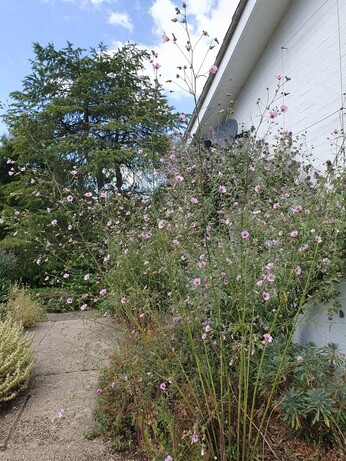
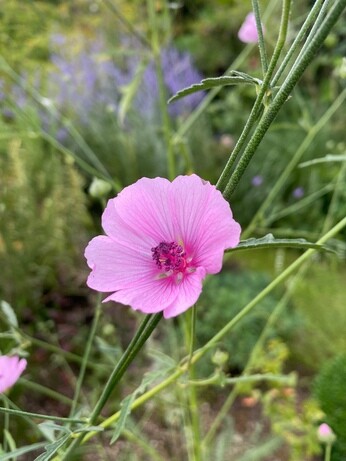
The tall, stiff, branching stems of Althaea cannabina give this hollyhock relative a wonderful see-through quality, with small pink flowers appearing over several months. When we’ve been talking to fellow gardeners about the plants that have performed particularly well this summer, this one and Verbena ‘Bampton’ have come up again and again.
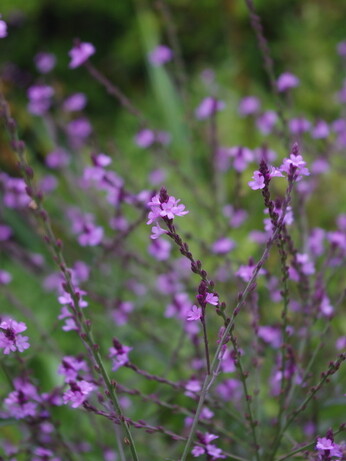
The young foliage of Verbena officinalis var. grandiflora ‘Bampton’ emerges almost black in spring, keeping an attractive bronze-purple tint throughout the summer. It will tolerate light shade, but for the best foliage colour, grow it in full sun. Its airy habit makes it a lovely plant to weave through other perennials and shrubs. Slender, wiry stems carry spires of tiny lilac-rose flowers throughout the summer.
Stipa gigantea, the golden oat grass, creates a wonderful shimmering veil, especially when backlit by sunlight. Unlike many of the denser, taller grasses, its open flower panicles are held high above the foliage on slender stems, giving it a lovely see-through quality. This makes it particularly useful even in a smaller garden, where it can add height and movement without feeling too heavy or taking up too much space.
More than just flowers
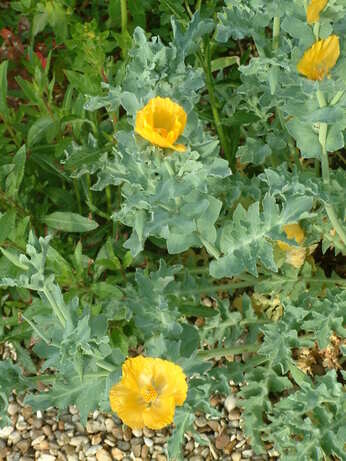
The horned poppy, Glaucium flavum, is a short-lived perennial, but it more than makes up for this by self-seeding freely. It forms handsome rosettes of deeply ruffled, blue-grey leaves, followed by poppy-like flowers, in shades of yellow or orange, throughout the summer. After flowering, long, narrow, curved seed pods appear, attractive in their own right. They add another point of interest once the flowers have faded, helping the plant to remain part of the picture for longer.
You will often find it growing naturally on stony beaches or shingle banks, which gives a good clue to the conditions it prefers. It is happiest in lean, well-drained soil; rich soil will almost certainly shorten its lifespan. Its deep taproot makes it’s difficult to move once established, but also helps it cope remarkably well with dry conditions, making it an excellent choice for a drought tolerant planting.
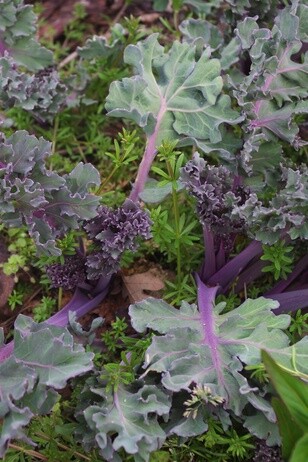
Crambe maritima, or sea kale, is as tough as they come, growing naturally on shingle beaches and other exposed coastal sites. Its striking wavy-edged, glaucous leaves are reason enough to grow it, but the profuse cloud of honey-scented white flowers in early summer makes it even more irresistible.
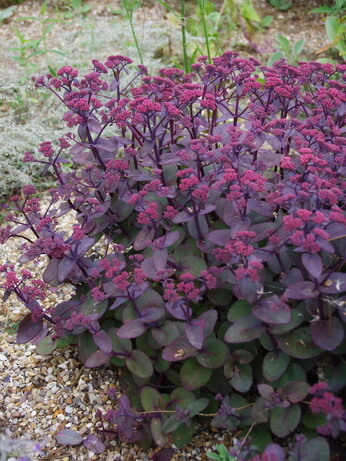
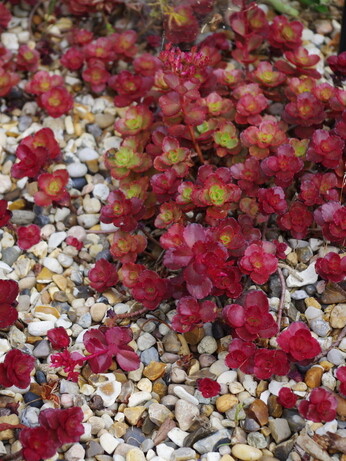
The hylotelephiums have also enjoyed the dry weather. Their fleshy leaves are well adapted to drought and their flat-topped flower heads of starry flowers provide a valuable source of food for hoverflies, bees and butterflies towards the end of the summer. Even after flowering the brown, dried seed heads remain attractive, adding interest to the garden into winter. Hylotelephium ‘Karfunkelstein’ has particularly dark foliage, with a blue sheen. For something lower, Sedum spurium ‘Schorbuser Blut’ forms a tough, spreading mat of toothed green leaves which take on red and purple tones as they mature.
A late-summer splash of colour
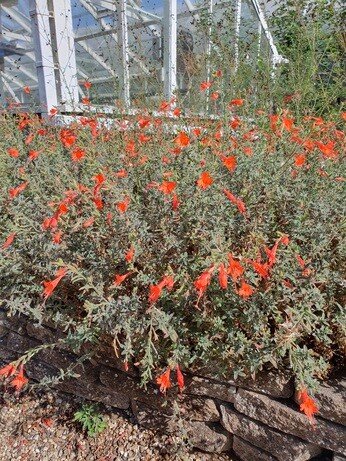
The Californian fuchsia, Epilobium canum, has been particularly good this year. It needs very free-draining soil to survive our winters, but we have grown it successfully in our Gravel Garden for many years. We never cut it back before winter. The old stems are left in place, giving the plant some protection if the winter should prove severe.
It’s not necessarily a plant that catches your eye in the nursery, but planted in the ground it is quite a different matter. Towards the end of summer, when colour is beginning to diminish elsewhere, it produces brilliant splashes of orange-red, bringing a welcome burst of colour to the borders. Its pollen-rich flowers are also a magnet for bees and hummingbird hawkmoths.
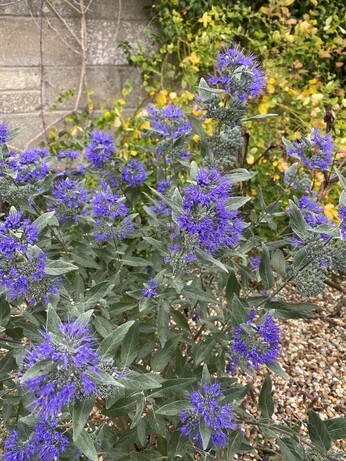
Caryopteris is generally happiest in a warm, sheltered spot. Even so, we were surprised by how well it stood up to the heat this summer. It barely seemed to notice it, producing its valuable haze of blue flowers in late summer when many other plants had finished flowering.
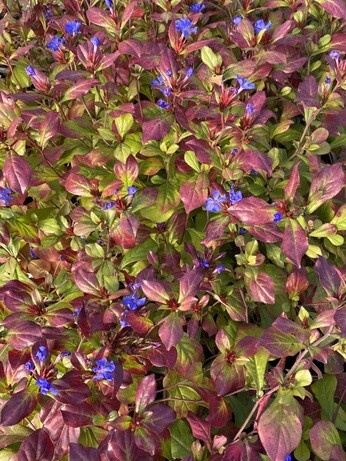
Ceratostigma plumbaginoides was equally unfazed. We value it not only for its striking blue flowers, which appear as summer begins to draw to a close, but also for its spectacular autumn colour. As the season progresses, the foliage turns rich shades of red, adding another layer of interest.
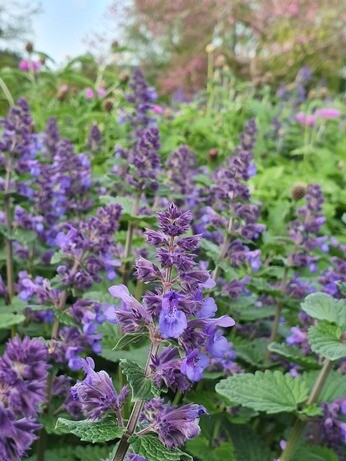
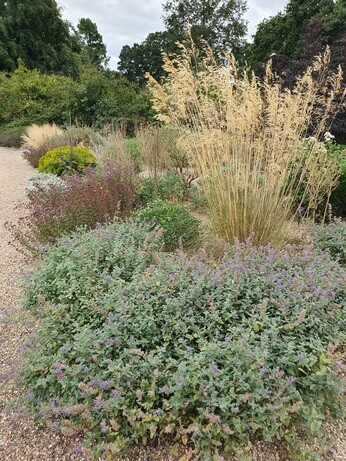
We’ve mentioned in previous blogs how impressed we’ve been with Nepeta ‘Chettle Blue’. Another, lower-growing catmint that we wouldn’t want to be without is Nepeta ‘Hill Grounds’, which has continued to look good and flower intermittently throughout the summer, giving a long-lasting presence in the border.
This year we decided not to cut it back after flowering as we usually do, and it has still rewarded us by remaining fresh and attractive. It is a useful reminder that plants do not always need our intervention. Sometimes, leaving them alone is the best approach.
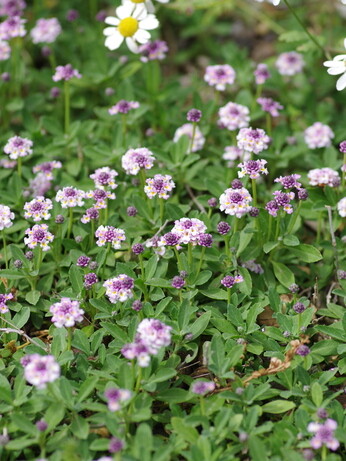
The low, ground-hugging Phyla nodiflora is another plant that has performed particularly well. It is ideal for planting where it can spill over the edge of a trough or low wall, bringing its tiny flowers closer to eye level so that they can really be appreciated. Planted in the ground, it forms a dense carpet and can even tolerate some foot traffic.
Also known as turkey tangle frogfruit, Phyla nodiflora is native to the northern parts of South America where it is sometimes used as a lawn substitute. In our climate it will usually lose its leaves during a cold winter but bounces back when spring warmth arrives.
Top performing plants for full sun and free-draining soil
Perennials
Agapanthus
Althaea cannabina
Berkheya purpurea
Crambe maritima
Erodium acaule
Erodium chrysanthum
Euphorbia 'Abbey Dore'
Euphorbia characias subsp. wulfenii
Euphorbia myrsinites
Euphorbia segueriana
Helleborus argutifolius
Hylotelephium
Foeniculum vulgare ‘Smoky’
Glaucium flavum
Gypsophila ‘Rosenschleier’
Nepeta ‘Chettle Blue’
Nepeta ‘Hill Grounds’
Oenothera lindheimeri (syn. Gaura)
Onosma alborosea
Phyla nodiflora
Pseudodictamnus mediterraneus
Salvia ‘Blue Spire’ (syn. Perovskia)
Saponaria x lempergii 'Max Frei'
Sedum
Verbena officinalis var. grandiflora ‘Bampton’
Annuals/biennials - establish better if sown in situ
Eschscholzia californica
Autumn flowering bulbs
Amaryllis belladonna
Sternbergia lutea
Grasses
Stipa calamagrostis
Stipa gigantea
Stipa splendens
Stipa tenuissima
Shrubs and sub-shrubs
Atriplex halimus
Buddleja
Bupleurum fruticosum
Caryopteris
Ceratostigma
Choisya x dewitteana ‘White Dazzler'
Cistus
Cytisus × praecox
Euonymus fortunei ‘Emerald ’n’ Gold’
Lavandula angustifolia
Phlomis fruticosa and other shrubby phlomis
Salvia microphylla varieties (we’ve used S. ‘Royal Bumble’ at Chattowood)
Salvia rosmarinus
Spartium junceum
Vitex agnus-castus
Yucca filamentosa
Yucca gloriosa
Yucca rostrata
What this summer has shown us
There is always something to learn from a difficult season. A hot, dry summer can reveal strengths that are less obvious in easier years, showing us which plants are genuinely well suited to the conditions in which we ask them to grow.
With our climate changing, we also need to be willing to adapt. A plant we always considered suitable for dry shade, for example, may struggle if summers become hotter and drier. Gardening is a constant process of observation and learning, so it’s important to keep an open mind, experiment and learn from each other’s experiences.
We would love to hear from you in the comments below – which plants have been your best performers, and what type of soil are you growing them in?


COMMENTS