
Find out what the propagation and garden teams have been up to this week.
Wild Words from the Ground - November
POSTED 3rd December 2025

Welcome to our blogs featuring the photos and sightings of wildlife in the garden (and outreach sites like Chattowood, the Meanwhile Garden and for the first time the Albert Roundabout) by our staff, whether in the office, shop, tea-room, nursery or garden. The images are curated and commented upon by Dr Chris Gibson, our Wildlife Advocate.
While the photos are not always of the highest quality – our staff are busy doing their main jobs! – they give a real feel of life in the garden, something we are very keen to encourage, as indeed was Beth.
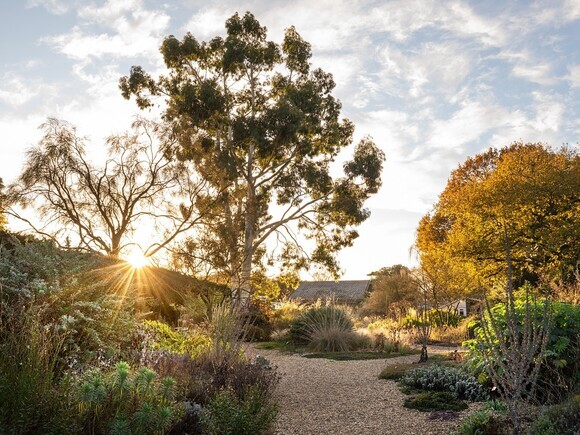
Winter starts here! Our wildlife news from the garden is now fading away with the season, but what has been reported speaks volumes about the preparations of nature for what may (or may not) be heading our way.
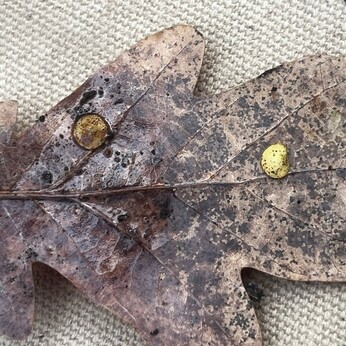
On turning over an old fallen oak leaf, Cathy was interested to find out what the disc-like structures were. Galls are chemically-induced structures produced by a plant in response to its infection by another organism, whether insect, mite, fungus, bacterium or a parasitic plant, and are often of a constant form so that the gall-causer can be identified without ever seeing it. These are a case in point: Neuroterus quercusbaccarum is a tiny, 2mm-long, black wasp, the summer females of which lay eggs in oak leaves; that triggers the formation of spangle-galls, so-called as when fresh they are spangled with rusty hairs. Each disc contains one developing larva.
These on a fallen leaf are a little tardy, as normally the galls drop off the leaves just before the leaf falls, and spend winter tucked beneath an insulating blanket of leaves. Spring adults then emerge from the galls in April; all of these are functionally female and lay eggs without fertilisation on oak catkins. These then trigger the growth of very different currant galls, the size, shape and colour of redcurrants. From the currant galls, the sexual summer generation then emerges, needing to fertilise before egg laying.
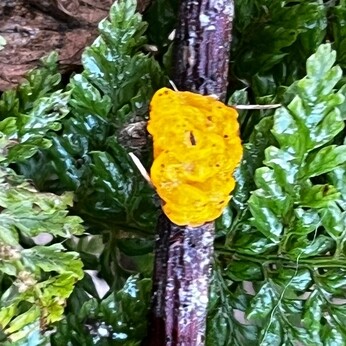
Galls can be found at all seasons, but they are normally most obvious in the autumn. The same can be said of fungi, as their fruiting is largely curtailed by the first frosts. But there are species that are characteristic of every season, even midwinter. One such was found by our volunteer Ed, brightening up even the greyest winter gloom, the Yellow Brain or Witches’ Butter. This is a jelly-like, amorphous fungus that is parasitic on crust fungi that grow on dead wood.
One bird that is always present with us, but is seen primarily in winter is the Barn Owl. The reason of course is that Barn Owls are most active at dawn and dusk, and it is only in winter that our staff are arriving and leaving when the owls are hunting. Rob managed a distant shot of one by the drive as he arrived towards the end of the month.

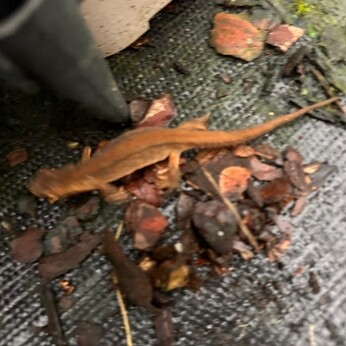
The only newt we have ever found in the Gardens is the Common (or Smooth) Newt. Like all newts they live and breed in water during the summer, but move out to nearby hibernation sites for the winter, so that they don’t get frozen in blocks of ice. As they move to their winter quarters they are more likely to be seen on land, snacking on small slugs and other invertebrates, which is hopefully what the one found by Kirsten was doing around the nursery!
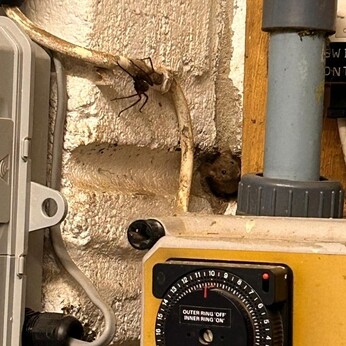
Kirsten also examined the inhabitants of our outhouses, eyeing each other up! The large house spider would probably come out worst in a tussle with the house mouse, but…
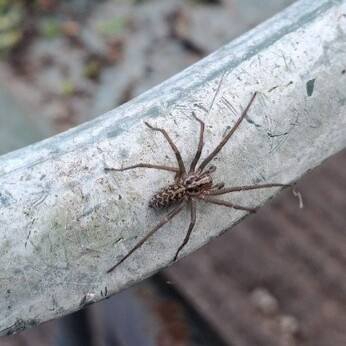
Rob also photographed a spider which may well be the same species although, evidently living outside, there are other possibilities. Whatever, lacking dark rings on its legs, it is one of the Eratigena species.
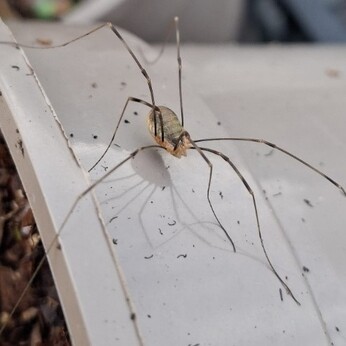
In the same major invertebrate grouping as spiders, harvestmen are similarly eight-legged (although their legs are easily shed, hence the one below has just seven). But whereas a spider’s body is clearly in two sections (cephalothorax and abdomen), the harvestman body is just one blob, and they hunt without using silk. This, also photographed by Rob, is Opilio canestrinii, now one of the commonest of the 30 or so British species even though it was first recorded in this country as recently as 1999.
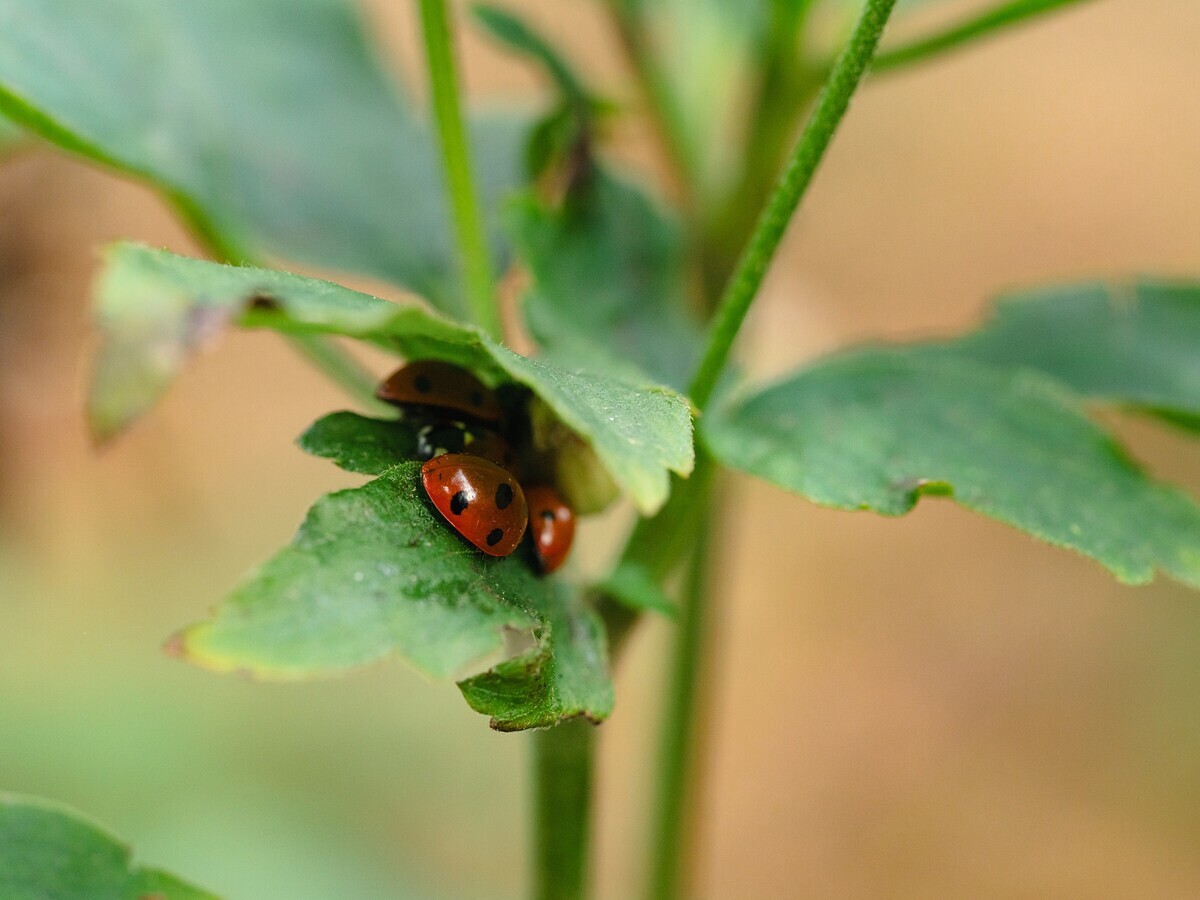
Another new arrival to Britain, this one in 2004, is the Asian Harlequin Ladybird. Its name comes from its extreme variability in colour forms, although all are variations on the themes of red-with-black-spots and black-with-red-spots, and the number of spots ranges from zero to 22. Rob’s photo shows one of the spotless forms, though the pale ground colour suggests this might recently have emerged from its pupa, and not yet developed its final adult coloration and pattern.
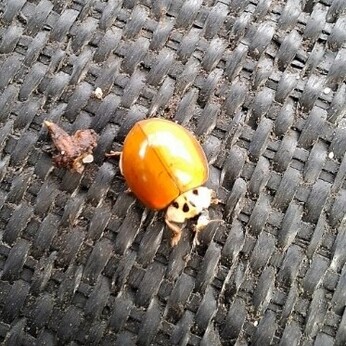
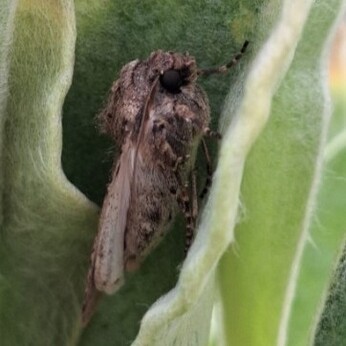
Over winter, adult Harlequin Ladybirds often roost communally in nooks and crannies inside and outside buildings. Insects show huge variation in their life cycle, and different species usually spend the winter in just one, sometimes two, of their developmental stages – egg, larva (or nymph), pupa and adult. The Turnip Moth is one that overwinters as a larva, and has both spring and summer/autumn broods of adults. So Rob’s photo from late November is of either a very late individual, or one whose development process has been modified by being in part protected from the open garden environment.
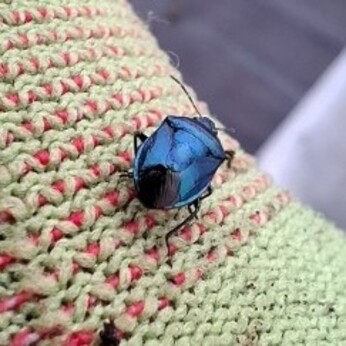
Finally, the cream of the crop this month is the first garden record of blue shieldbug, found by Miya. Although reasonably widespread in Essex, there are only a couple of records from the Tendring Peninsula, east of Colchester. It is an unmistakeable, shiny bluish-black shieldbug, one that is a predator of various leaf-beetles and therefore to be welcomed in the garden as not only a magnificent adornment but also a useful friend!
For a different perspective on the last month, see my personal blog from November:
The Wild Side of Beth Chatto Gardens: Winter arrives! | Chris Gibson Wildlife
The insects may be fading away but there is always something to see round the Gardens. Indeed it is at this time of the year, when there are fewer people wandering around, that birds can be most numerous: look out for Siskins and Redpolls in the Alders, Redwings and Fieldfares on the ripe berries, and a fly-past Kingfisher over the ponds, among many others. But please note we will be closed December 23rd - February 2nd inclusive, opening again in time for the first flush of Spring 2026!
COMMENTS