Welcome to our blogs featuring the photos and sightings of wildlife in the garden (and outreach sites like Chattowood, and the Meanwhile Garden and Albert Roundabout in Colchester) by our staff, whether in the office, shop, tea-room, nursery or garden. The images are curated and commented upon by Dr Chris Gibson, our Wildlife Advocate.
While the photos are not always of the highest quality – our staff are busy doing their main jobs! – they give a real feel of life in the garden, something we are very keen to encourage, as indeed was Beth.
July 2026: the month without a drop of rain. Yes, we are now officially in drought conditions and the Essex landscape is turning ever browner by the day. But our gardens, especially those on the dryest soils, are able to buck that trend, bringing some resilience to the world by relying on Beth’s principle of ‘Right Plant, Right Place’. Our use of drought-tolerant plants means we keep some green in the scene, without placing any demands on our most precious water resources, when all around is frazzled.
And Nature responds accordingly. Whilst it has been possible to walk around Essex this month and see barely any wildlife in the hedgerows and fields, especially in the heat of midday, in our gardens the buzz of high summer has continued. Yes, it may have been subdued, but there are still flowers to feast upon and, importantly, leaves to hide amongst when things are simply too hot.
July is always one of the peak periods for moths, but as the blog of my two moth trapping events this month indicates, the heat and drought have probably affected both numbers and diversity, even of this largely nocturnal group July Moth Morning 2026 at Beth Chatto Gardens | Chris Gibson Wildlife. But there was still plenty for the attendees to see, and hopefully the kids (of all ages!) at the children’s event all came away with the thrill of a deep dive into nature.
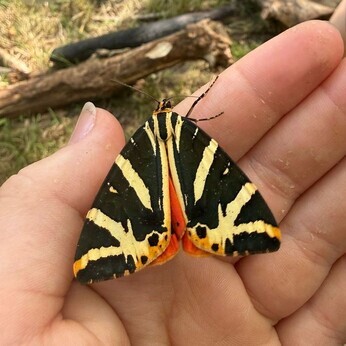
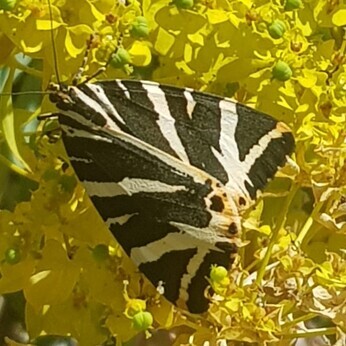
But not all moths are exclusively nocturnal, and one of Nicola’s kids’ groups came face-to-face with one of the biggest and brightest, a Jersey Tiger, something so spectacular it may just change some little lives!
Jersey Tigers always attract attention: here’s one that Emily photographed. But going back as few as twenty years, they were a near-mythical beast of southern shores, found in the UK only along the extreme south coast and in the Channel Islands. Presumably in response to climate change, they started to spread, into London, then up the Lee Valley, then across Essex, finally reaching us about five years ago. Wonderful to see … but always sobering to remember this is only because of the changes wrought by our pollution and perturbation of the atmosphere: warming leading to weirding and now as we can unfortunately see, likely climate collapse.
Another delight found by one of Nicola’s educational groups was a Buff-tip, a nocturnal moth that often appears in the moth trap but is rarely seen by day, no doubt because it hides in plain sight as a birch twig!
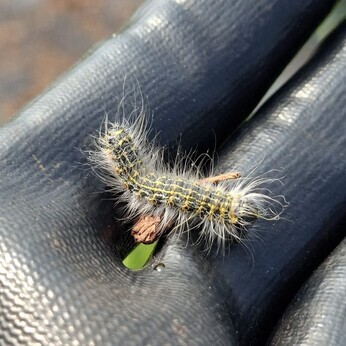
At this time of year, Buff-tips can be found as both adults and caterpillars. Rob photographed one of the latter, sensibly while wearing protective gloves. While this species seems not to be one of the worst offenders, all hairy caterpillars are liable to cause a skin rash if handled, so better safe than itchy!
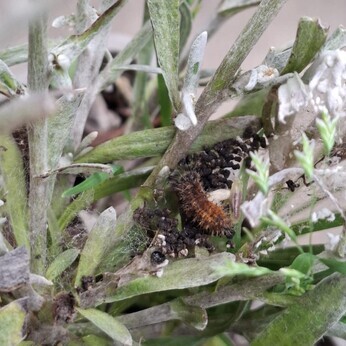
Another hairy caterpillar this month was a Ruby Tiger eating Debs’ pots of Helichrysum. As we pride ourselves in being the home of ecological and sustainable gardening, my advice was not to kill the unfortunate, unwanted beastie but to translocate it into the garden when it can make its own way in the wider world.
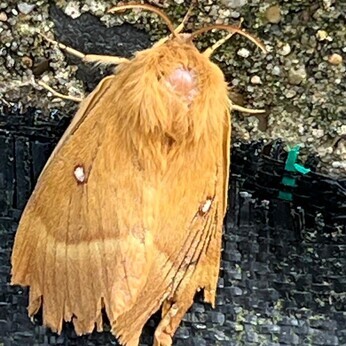
And a final couple of adult moths, found by day. Mel was very taken by the ‘little ginger, beardy face’ of the Oak Eggar. And Scott remembered what it was, having seen it a week previously at the kids’ moth trap event. Indeed, it could conceivably have been the very same individual: the first was fresh, the second rather tattered, and they are strong fliers so could turn up anywhere in the garden or nursery.
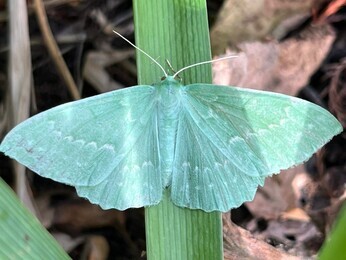
For me, one of the loveliest moths we have is the Large Emerald, and Cathy pictured it perfectly to show the jade-green of its wings contrasting with the grass-green leaves.
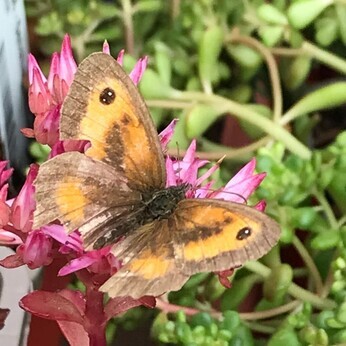
With all the moths around, there was the risk of our butterflies being sidelined. But everyone noticed the abundance of Gatekeepers, especially nectaring on Origanum and Nepeta. Gill’s photo is of a poor old tatty individual that has been around the block a couple of times and looks as though a bird might have had a go at it when at rest, judging from the identical damage to the hind wings. But even in this condition it is easily differentiated from other brown butterflies as it has two white pupils in each black eyespot.
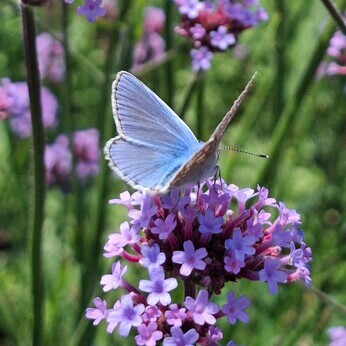
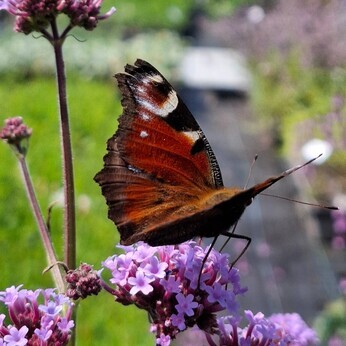
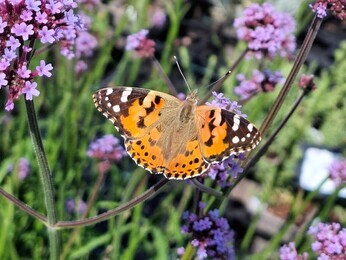
Rob also spent a very productive time immersed in the Verbena bonariensis and photographing all the butterflies attracted to it, here a male Common Blue, a Peacock also showing signs of wear, and a pristine Painted Lady, presumably the freshly emerged offspring of one of the migrants that arrived from late spring onwards.
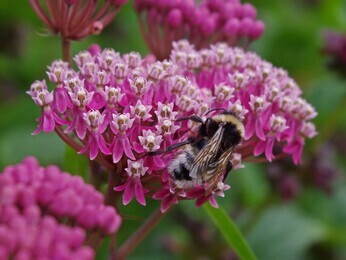
While bees have been around in reasonable numbers, bumblebees especially seemed to have avoided the hottest time, no doubt taking refuge in shade to avoid the risk over overheating within their fur coats. Steve managed to get this excellent photo of a Vestal Cuckoo-bee. Cuckoo-bees are a subgenus of bumblebee, in which the females kill a queen true bumble, and lay their own eggs in her nest for the bumble workers to rear. Different species are cuckoos of different bumbles and vary in pattern to resemble their host: this is a brood parasite of Buff-tailed Bumblebee. In general terms, cuckoo-bees have thinner fur, tinted wings and lack the pollen baskets of their host species.
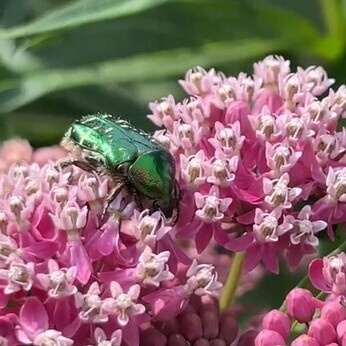
Munching the flowers of the same Asclepias, a Rose Chafer was also filmed by Steve. This large, metallic beetle is unmistakeable and a real speciality of north-east Essex, but sadly seems this summer to have been relatively scarce in our garden. However, since it may munch dead wood and compost for several years as a grub, low numbers of adults in one year are no measure of numbers in subsequent summers. The important thing is to provide the larval food resource, which of course we do in abundance, although it has to be said that drought might well affect the quality of that resource.
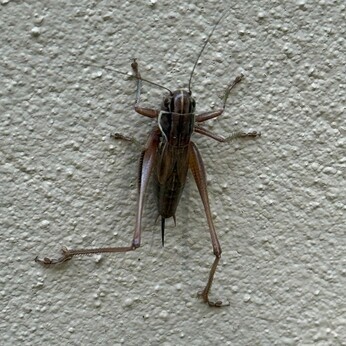
The final insect of this month’s round-up is a Roesel's Bush-cricket, again photographed by Nicola. Although it is a common enough insect in grassy areas around the garden, it is not one I see very often, probably because one’s attention is normally grabbed by its insistent ‘reeling’ song, like a freewheeling bicycle. Sad to say, I am old, and my hearing lost its sensitivity to such frequencies about three years ago. I realised only when my then five-year-old granddaughter Eleanor started asking me what the song in the bushes was. I could hear nothing...
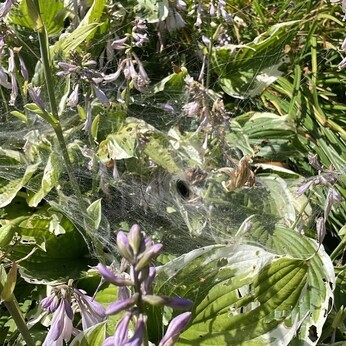
Moving on to the spiders, which come into their own in late summer, Malin photographed an extensive funnel-web, probably belonging to a Labyrinth Spider. The female spider lives in the bottom of the tunnel, coming out when she feels the vibrations of prey trapped in the web, or the signals of a male tapping on the web to get her excited, hopefully for mating, not food! This funnel-web spider is harmless to us, of course, unlike the unrelated, deadly Australian funnel-webs.
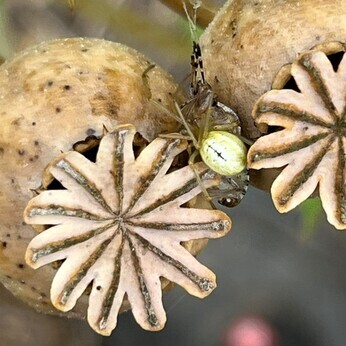
Cathy found one of the comb-footed spiders, Enoplognatha sp. These species, inseparable except under a microscope, can have beautiful pink stripes, and so is often called the Candy-striped Spider.
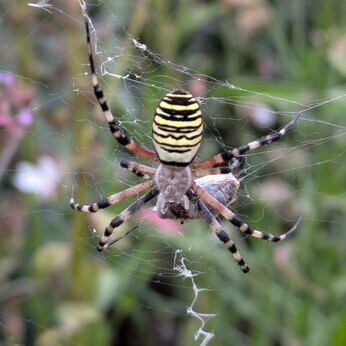
But needing no introduction, Malin also found a female Wasp Spider, now becoming an expected, unmistakeable feature of this season, having spread from the deep south from the last decade of the 20th century. This photo shows well the zigzag stabilimentum that characterises the web of this species, probably to give it the strength to withstand the kicking of trapped grasshoppers that make up the bulk of this spider’s diet.
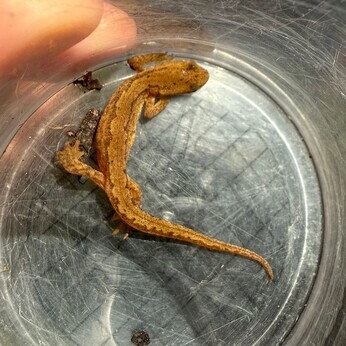
For our final wildlife news of the month we move to the vertebrates, and more concerns relating to climate collapse and extreme weather. Nicola found a Smooth Newt under a log, not unexpected at this time of year as they can move onto land straight after breeding and spend the winter there. But on land they are very vulnerable to drought, and what if their essential aquatic breeding sites fail to refill…?
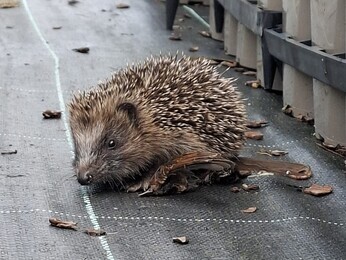
Then behind the scenes, Annie was excited to find a Hedgehog scavenging on the carcass of a House Sparrow. Excited but concerned: it really should not be out in full daylight unless it was ill or stressed by the heat. So, with Rob, she swept into action, removing it to the shady woodland garden and given some cat food to help it settle in. Fingers crossed, for the Hedgehog and indeed for all we share the garden with at such difficult times.
For a different perspective on this month’s wildlife, have a look at my personal blog:
The Wild Side of Beth Chatto Gardens: another dry July… | Chris Gibson Wildlife
Indeed, you could look at the whole archive of my blogs relating to Beth Chatto Gardens, going right back to 2018, all listed on the page Beth Chatto Gardens – activities, events and blogs | Chris Gibson Wildlife
Who knows what the next month will bring. The forecasts seem not to have any rain in them so far as can reasonably be seen, but just perhaps we are past the peak of the ferocious temperatures. But the teams will still be out there helping maintain our very special ‘garden nature reserve’, and if anyone wants to join me on a Wildside Walk around the garden on either the 7th or 21st of August, you can book through the website at Courses & Workshops - Beth Chatto's Plants & Gardens.



COMMENTS