Welcome to the second year of our series of blogs featuring the photos and sightings of wildlife in the garden (and outreach sites like Chattowood and the Meanwhile Garden) by our staff, whether in the office, shop, tea-room, nursery or garden. The images are curated and commented upon by Dr Chris Gibson, our Wildlife Advocate.
While the photos are not always of the highest quality – our staff are busy doing their main jobs! – they give a real feel of life in the garden, something we are very keen to encourage, as indeed was Beth.
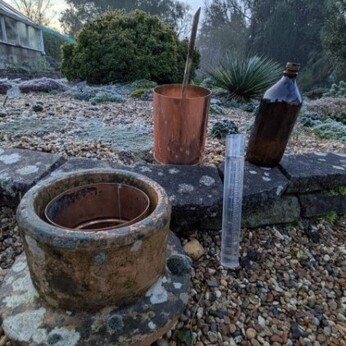
The depths of winter are not the time when we expect to be reporting much wildlife around the garden. The days are short, often cold, and this winter at least, very often very wet! Scott, reporting from the rain gauge, recorded three 30mm+ rain days in January alone, reflecting the month’s three named storms: Ingrid, Goretti and Chandra, adding up to the largest single month’s rainfall since November 2023, and approaching a third of the expected annual total. ‘Expected’, that is, based on the recent past, but this is the reality of climate change. It isn’t ‘global warming’ or even ‘global weirding’ any more, it is catastrophic climate collapse. Like all aspects of our lives, our gardening habits will have to change, but we shall be at the forefront of that. ‘Right plant, right place’ has to be the way forward into a future more in harmony with the world.
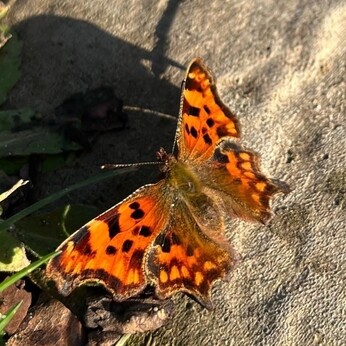
In fact it is hard to think back to those halcyon dry days of December! Often sunny and for the time of year rather warm, the occasional butterfly remained on the wing just into the period covered by this report. Steve’s photo is of a Comma, one of the five species that overwinter as adults, mostly torpid except on a sunny day.
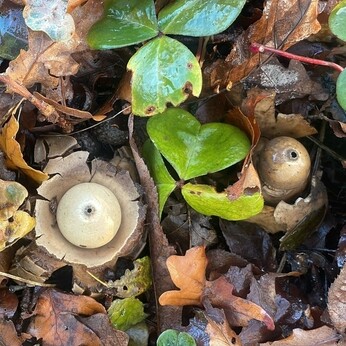
Autumn and winter are an important time for recycling the growth of the previous summer and the past couple of months have seen some very interesting records of fungi, recyclers par excellence. Malin was lucky enough to spot Collared Earthstars in the Woodland Garden. Very distinctive, this species is pretty uncommon in Essex, and this represents its first recorded occurrence in the Gardens. And they were still to be seen there a week later when I was able to get over to see them!
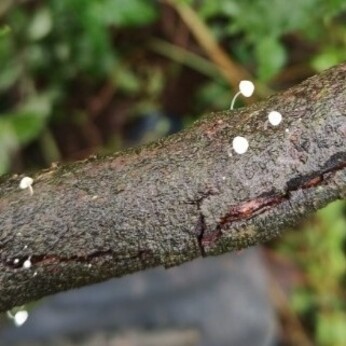
After New Year, Mattie’s sharp eyes picked out some small, white mushrooms erupting from a dead twig. These are a type of fairies’-bonnet Mycena adscendens, sometimes known as the Frosty Bonnet. This is a much more widespread and frequent fungus than the earthstar but, reflecting the fact that we have never set seriously about identifying fungi in the Gardens, it is recorded as new to our list.
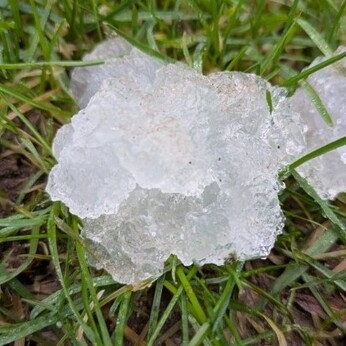
Around the same time, semi-transparent jelly-like blobs started to ooze out of the lawns, found by Mattie and photographed by Scott. It is somewhat reassuring to think that in our sometimes over-rationalised world, this phenomenon remains mysterious and is given the suitably ambiguous name of ‘star-snot’. Some suggest that the blobs may be fungal in origin, though they do appear to be wholly unstructured. Others suggest it may be the gelatinous exudates of a bacterium-like blue-green alga called Nostoc, while a theory connected with the time of year and start of the amphibian breeding season suggest that it may be a frog’s remnants (specifically the lining of its oviduct) after it has been eaten and (understandably!) regurgitated by a predator.
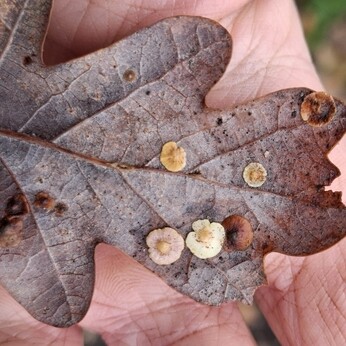
Galls are also a very much a feature of autumn, and they often hang over into the winter. Rob found these spangle-galls caused by the tiny wasp Neuroterus quercusbaccarum underneath a fallen Oak leaf. In fact, the galls often fall from the leaves just before the leaves themselves fall, so that the leaves help to insulate the galls in cold weather. In this case though, for whatever reason, they all fell together. But what attracted him was the subtle mix of colours of the galls. It may be that the different colours represent different things going on inside the gall: in the brown ones, the wasp grub has probably died, while the paler ones contain living ones and/or hyperparasites. There is a whole ecosystem inside the enclosed confines of a gall!
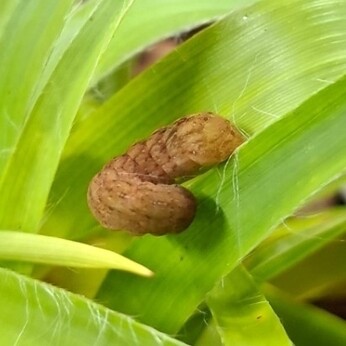
Winter can of course be a good time to find the larvae of many insects, and Kathy photographed this caterpillar munching away on a Luzula leaf. Unfortunately, caterpillars can be hard to identify, especially as they often look very different at different stages of their growth. But this will probably develop and emerge as a lovely Angle Shades moth in the spring.
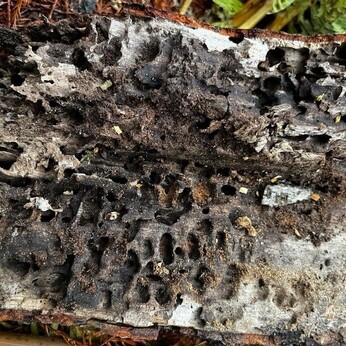
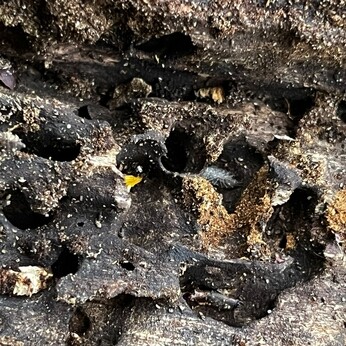
Out in the garden, a Prunus lusitanica was cut back, and Cathy found some of the logs to be riddled with large feeding holes. There are probably the galleries created in dead wood by the grubs of Lesser Stag-beetles, much the commoner of the two stag-beetles and the one that lives mostly in above-ground dead wood.
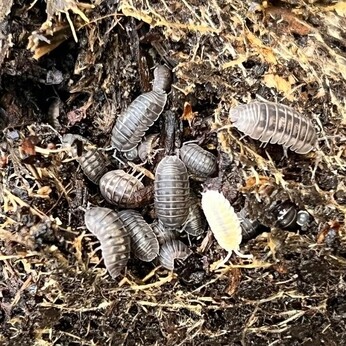
Sometimes one has to delve around among soil, compost and roots to find interesting wildlife. Mel was doing just that and found this aggregation of Nosey Pill-woodlice: ‘pill’ because they can roll into a tight ball, and ‘nosey’ because they have a ‘snout’, like the peak of a baseball cap, protruding between the base of the antennae. This is another species not previously recorded in the Garden, and indeed there are only about three other known sites in Tendring District. She was especially drawn to the white one: the white colour is because it has let air under its exoskeleton, loosening the shell from the body. Shortly the shell will split around the midriff, and a larger individual will emerge: it’s how they grow!
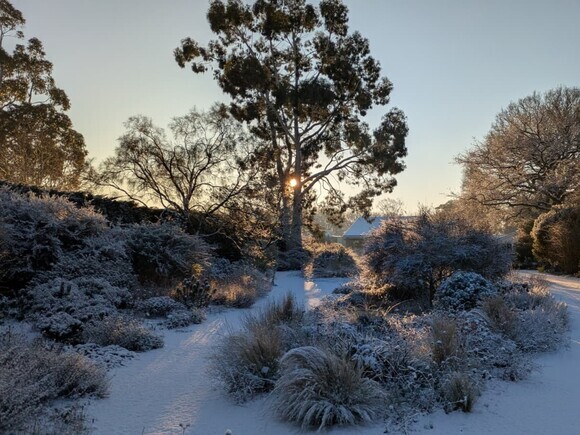
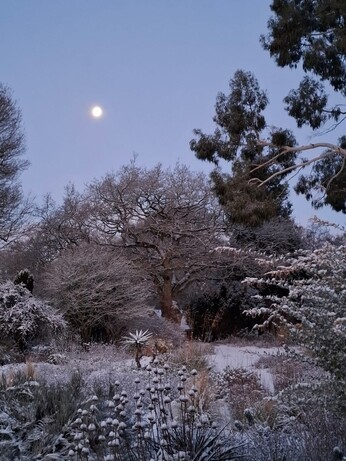
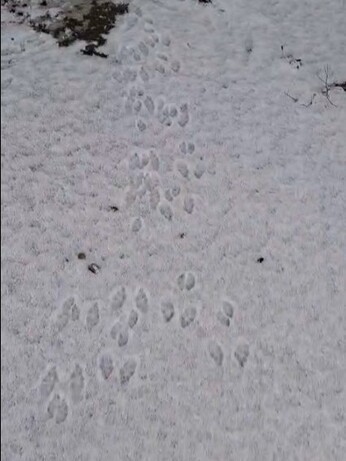
Just after New Year, we had a short spell of proper wintry weather, with at least a light snow covering. Rob captured this lovely photo of the setting Wolf Moon, along with evidence of nocturnal goings-on, in the form of Rabbit activity…
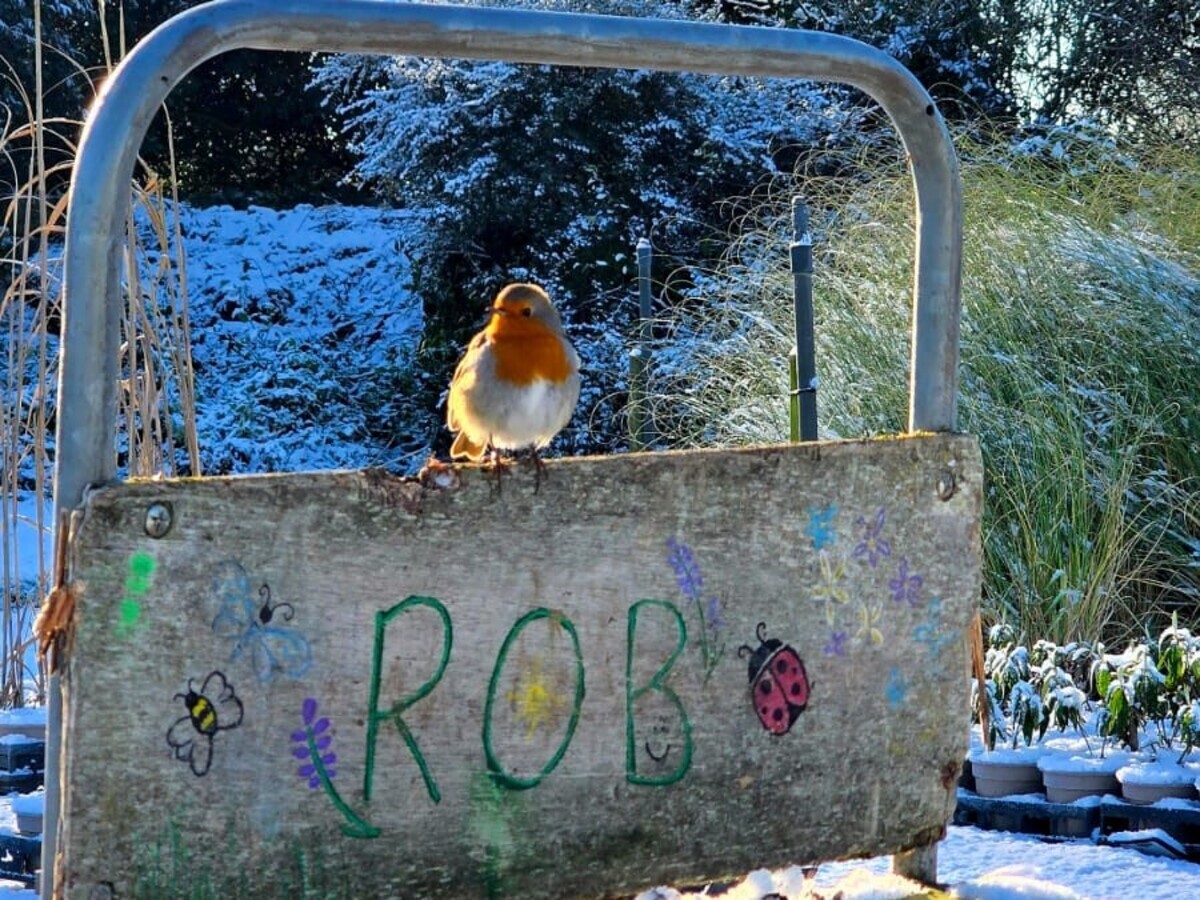
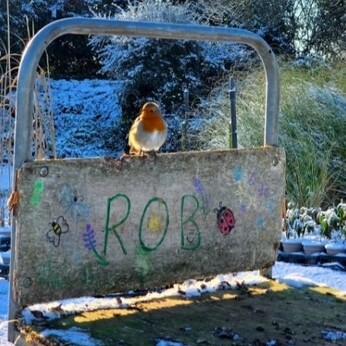
The Gardens were closed to visitors for the whole of January, so I thought a visit would be in order to see if and how the birds around the garden responded to the relative lack of disturbance. Aside from a few more Mallards on the ponds, though, I could see and hear very little difference: Robins and Song Thrushes in full spring song, along with Blue and Great Tits constituting the bulk of the soundscape. High in the treetops, bands of Fieldfares and Redwings were on the search for ripe berries, while Goldfinches foraged in the seedheads still standing proud in the borders and beds. It really seems that the birds we share the space with are not significantly impacted by our presence: our human garden visitors are respectful of nature and they do not come trailing dogs, the greatest disturbance factor of all. Of course some birds are positively attracted to our activities, as the Robin in Pete’s photo, hoping his work will uncover a tasty morsel, especially important on a cold, snowy day.
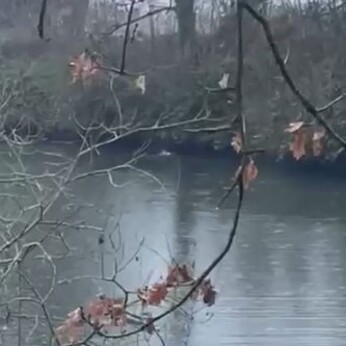
Mammals are perhaps even more prone to disturbance, so it isn’t a surprise that I saw a Muntjac in the Woodland Garden, the only time I have seen one in the public area. And another long-awaited mammal was seen for the very first time, in the Reservoir. Scott was so excited to come face-to-face with it at the start of January, but even more disappointed not to be able to capture it on his phone. However, at the end of the month, Malin spotted it again and took a video, a still from which is shown below, the Otter being the splashing at the far side of the pond. Let’s hope it is here to stay: they are to be found on all rivers hereabouts, albeit sparsely, and in some parts of East Anglia, notably at Thetford, they often become visitor attractions, fully habituated to us watching them from the banks.
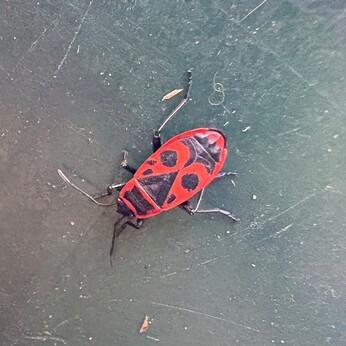
And finally, as January closed, David reported back from Colchester’s Meanwhile Garden on his discovery of the first Firebug of the year, just becoming active in the sun and bringing hope for the return of light, warmth and life. The Meanwhile Garden is a site that become occupied last summer by this distinctive species, established in mainland Britain only some five or six years ago. From its colonisation epicentre around Harwich, it is now to be found widely in the south-east. When will we see them reach our main garden? It could be this year, and it is no cause for concern given that it feeds only on the seeds of lime trees and mallows. Something else to look forward to!
For a different perspective, see my personal blogs from these two months:
The Wild Side of Beth Chatto Gardens: settling in for the winter pause… | Chris Gibson Wildlife
The Wild Side of Beth Chatto Gardens, awakening from winter slumber | Chris Gibson Wildlife


COMMENTS