
Mattie our Trainee reflects on their year spent gardening here at Beth Chatto's Plants & Gardens.
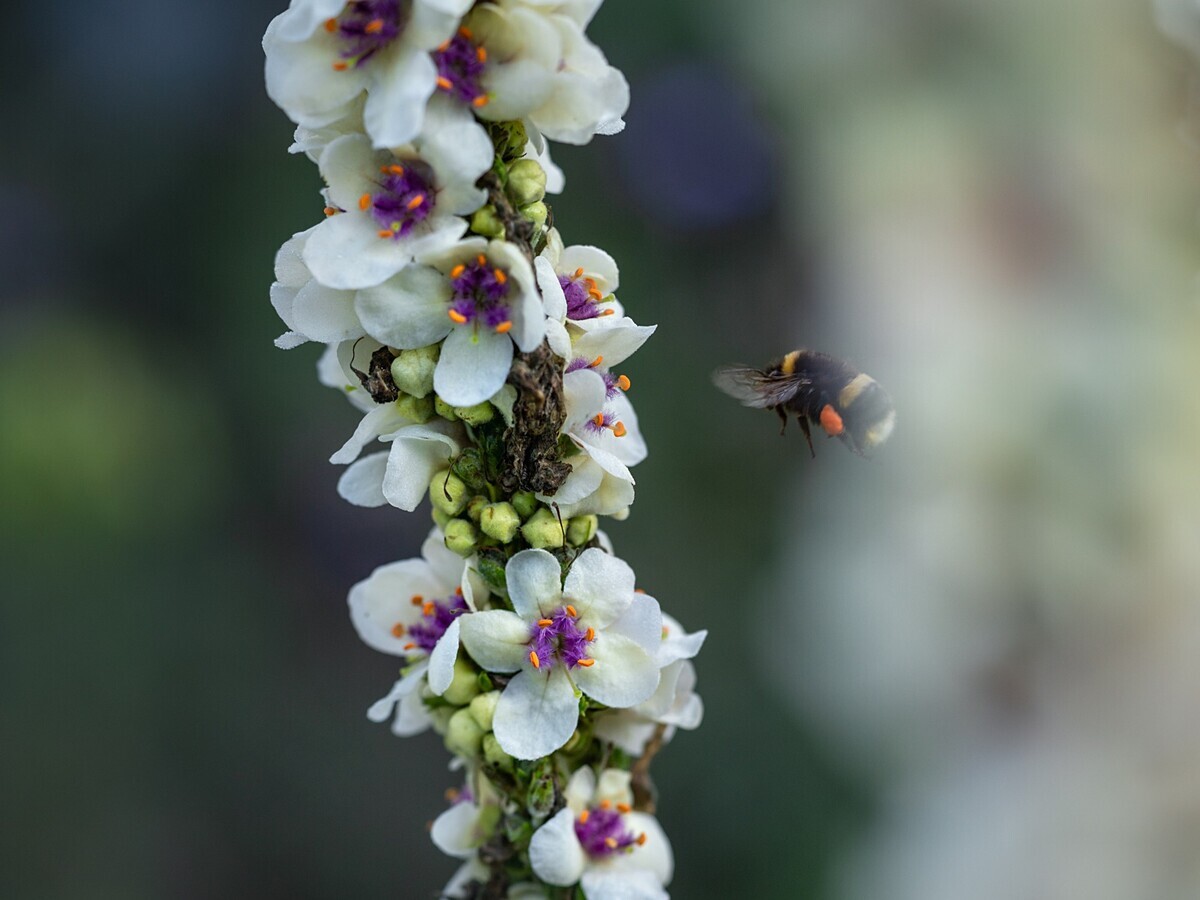
Wild Words from the Ground - September
POSTED 30th September 2026

Welcome to our blogs featuring the photos and sightings of wildlife in the garden (and outreach sites like Chattowood, and the Meanwhile Garden and Albert Roundabout in Colchester) by our staff, whether in the office, shop, tearoom, nursery or garden. The images are curated and commented upon by Dr Chris Gibson, our Wildlife Advocate.
While the photos are not always of the highest quality – our staff are busy doing their main jobs! – they give a real feel of life in the garden, something we are very keen to encourage, as indeed was Beth.
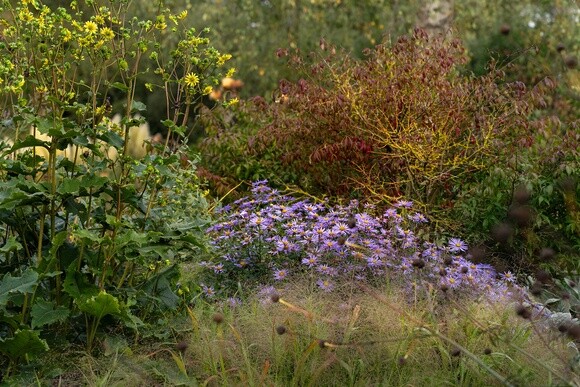
Summer may be over, but nobody told the weather! Right to the end of September there were still some really warm days of bright sunshine. There had been 30mm or so of rain, but the grateful earth swallowed it down without it touching the sides.
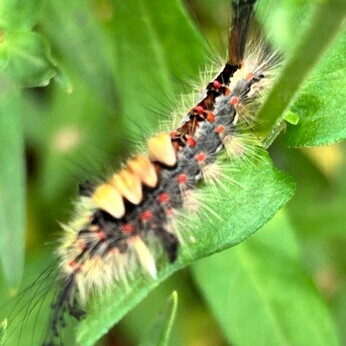
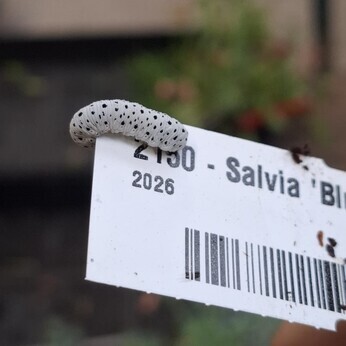
At this time of year, one’s attention is often dragged away from the here-and-now to the start of next summer’s wild show, in the form caterpillars munching our plants. Thankfully, we welcome all wildlife, and we wear holes in leaves as our badge of honour: no insects were harmed in the creation of this Garden, at least over the past five years. Kirsten found what she described as ‘a funky little chap on Lythrum’. How better to describe one of our most distinctive moth caterpillars, the Vapourer?
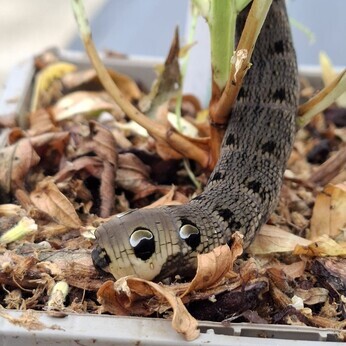
Kirsten also found, and Rob photographed, a huge Elephant Hawkmoth caterpillar munching the produce...
But not all caterpillars will turn into moths or butterflies if they survive: the larval stages of many sawflies are very caterpillar-like – cylindrical, sometimes well marked or distinctively coloured, with six true legs and a series of fleshy prolegs, driven by hydraulic power rather than musculature. But herein lies a key difference: lepidopteran larvae have five or fewer pairs of prolegs, whereas sawflies have six or more pairs. To add to the confusion sawflies are not flies at all: they are actually Hymenoptera from a very ancient lineage that pre-dates bees, wasps and ants. They are ‘wasps without wasp-waists’ that lay their eggs in plants using their saw-like ovipositor, and whose larvae are exclusively herbivorous. Jack found, and again Rob photographed, a larva of Figwort Sawfly. This has been found previously in the Garden though the adults, wasp-like in colour to provide some defence through mimicry, are seen more often. At first glance, especially being found on Verbascum or Buddleja, it could be mistaken for the familiar caterpillar of Mullein Moth – could this be another example of mimicry?
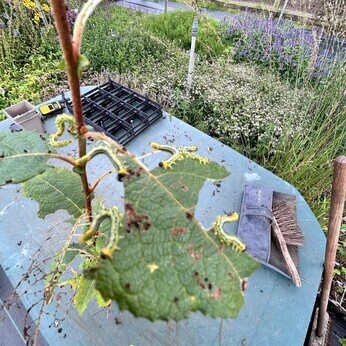
Another sighting from Kirsten, and again a sawfly. These little but voracious munchers on a Sallow are the sawfly Euura pavida, the first record for our Garden! The National Biodiversity Network Atlas shows only three sites in Essex, but this is likely because sawflies are not an especially popular group for recorders. Sawfly species with aggregated larvae often respond to a perceived threat by rearing and waving about: it is suggested this is an attempt to avoid being pecked off by a bird as they resemble tiny snakes. You might find this a bit fanciful, given they are only about 15mm long at most, but they are certainly a bit disconcerting when waving in unison.
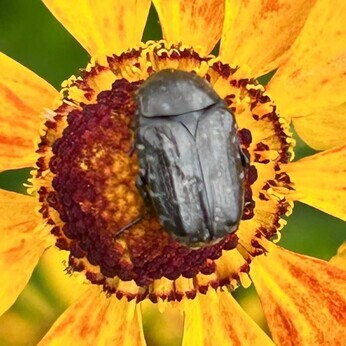
Moving on to the beetles, Kirsten again came up with the goods in the form of the third Garden record of the Spotted Flower Chafer, visiting the Helenium. A familiar Mediterranean species, it is a new colonist of Britain, with few Essex records so far. We had individuals in both May and June, and this latest record suggests that we now have it breeding with us. We can spare a few stamens and petals to feed these wonderful beasties.
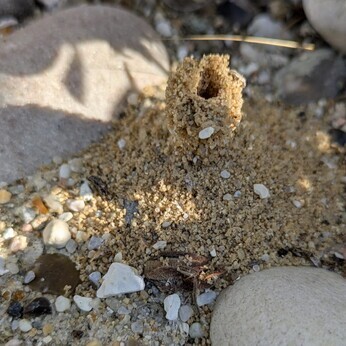
Over in the Chattowood sand gardens, Scott has always been interested in the colonisation of bare sand by ground-nesting solitary bees and wasps, most numerously Ivy Bees. The main colonisation starting in the third summer after planting, perhaps after a biofilm had formed on the sand surface, helping to hold the grains together so that a nest hole doesn’t crumble. This year he noted for the first time nest burrows extended outwards in the form of a ‘chimney’. Unfortunately, he has not yet tracked down the occupants but they could be very interesting: mason wasps (some very rare indeed) can make nests like that. So we will be looking out for them!
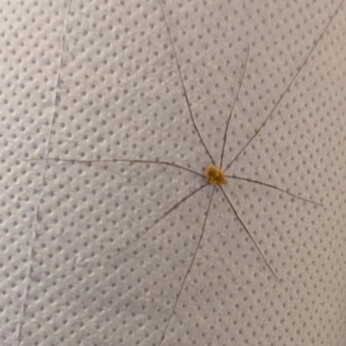
Scott also sent this photo of a harvestman Opilio canestrinii. Related to spiders (eight legs, though often some drop off), harvestmen have all their body in one blob, whereas spiders have a distinct head/thorax attached to the abdomen. While all spiders and some harvestmen are predators, other harvestmen are detritivores, helping clean up the world in their wake. This harvestman is another new colonist of the UK, first found in 1999, but now even up into Scotland. In the Garden we have recorded then only for a couple of years or so.
Mostly I am able to identify the things that catch the attention of Team Chatto members, but sometimes I have to admit defeat: I know my limitations! In the early part of the month, Rob found a new purpose in life when he came across some strange pebble-like blobs on top of bark mulch. His first thought was some form of worm-cast, but when he started to investigate further, he decided to cut one open and discovered it was bright orange! So he came to the tentative conclusion, after much research, it might be the dormant stage of a slime-mould.
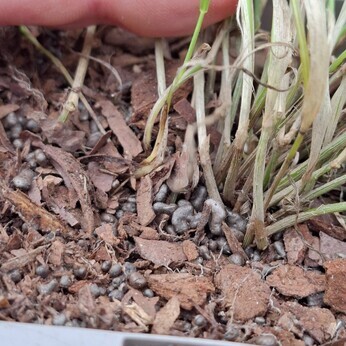
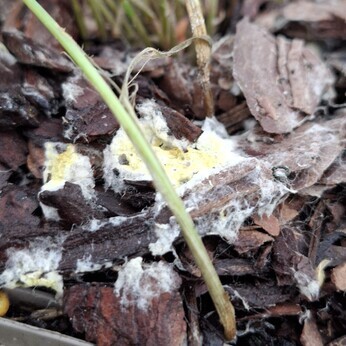
I was stumped, but felt Rob might have made a very good call, the resting stage of some slime-mould when it just sits there awaiting the call of nature to start sliming. Which the cells do, en masse, finding partners and place to reproduce. So I suggested he keep an eye on the blobs and if they change shape or colour, another photo might help to identify them. A man on a mission, he did just that and a week later he came back with images of the slime-mould sliming around, and showing a strong yellow colour that would be typical of Fuligo septica, the Dog’s Vomit Slime-mould. Slime-moulds are not actually fungi, but an entirely separate division of life, closer to the bacteria. They are harmless to plants and, if anything, their presence will improve soil and compost as they are breaking down organic waste and recycling the nutrients. Rob discovered the latter information and duly informed the whole team: I think we have a new convert to the organisms that are the essential powerhouse of the cycle of life → death → decay → life … ad infinitum.
If slime-moulds are Rob’s current favourites, mine are Firebugs, and I make no excuses for returning to them once more. They seem to have crossed the Rubicon of widespread colonisation: our first in the Garden was in April, about six years since they started to pop up along parts of the Essex coast. Ours really took off last month, at the same time as reports started to circulate of them appearing in a wide swathe of the south-east, from East London to North Norfolk. They feed on the seeds of Malvaceae, including lime trees which are now included in that family, but it now seems their diet may be becoming more varied. In the garden I have seen them on Hyssop (Lamiaceae), elsewhere on Creeping Thistle (Asteraceae), while I have also heard of them on Lucerne (Fabaceae). And in the Garden, Mattie photographed them on Limonium (Plumbaginaceae) while in the Meanwhile Garden David reported them on Hylotelephium (Crassulaceae).
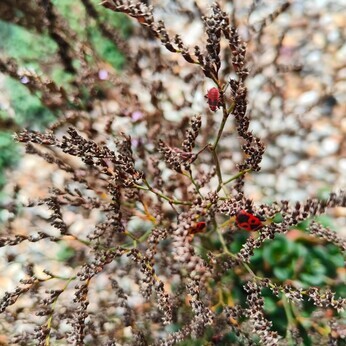
It is not clear whether they were actually feeding on the seeds of all those plants outside of the Malvaceae, but some certainly seemed to be. It seems the books may be being rewritten, and perhaps not surprisingly: an expanding climatic envelope of favourability may be enabling them to persist on a wider range of foods that are not super-optimal. This phenomenon is well known ecologically, and brings the prospect that we might see, as a small climate crisis bonus (goodness knows we need some of those!), for example Swallowtail butterflies breeding on our Fennel and other umbellifers rather than being confined to Milk-parsley in the Norfolk Broads...
For a different perspective on this month’s wildlife, have a look at my personal blog:
The Wild Side of Beth Chatto Gardens: September – a garden of two halves… | Chris Gibson Wildlife
Indeed, you could look back at the whole archive of my blogs of Beth Chatto Gardens, going right back to 2018, all listed on the page Beth Chatto Gardens – activities, events and blogs | Chris Gibson Wildlife
So what is to come? Well, that really depends to a great extent how much it rains. If we have a wet month and it remains warm we could see a wonderful fruiting of autumn fungi given the accumulated heat of the last year…but no rain would mean no, or very few, fungi. It is even more difficult the predict the intensity of autumn leaf colours, particularly as this summer has driven some plants into full autumn plumage already. And will the already ripened berries survive long enough to welcome the anticipated influx of Redwings and Fieldfares from norther climes over the next month?
So many unknowns in an increasingly chaotic world, but one thing is for sure, there will be staff out there looking, our eyes and ears on the ground!
COMMENTS