
Find out what the propagation and garden teams have been up to this week.
Connections Through Time: Reflections from the Beth Chatto Symposium 2026
POSTED 4th September 2026

Reflections from the Beth Chatto Symposium 2026
The fourth Beth Chatto Symposium brought together gardeners, designers, scientists, artists, ecologists and plant lovers from across the UK and around the world for three days of inspiring lectures, incredible conversations and workshops at the University of Essex and Beth Chatto’s Plants & Gardens.
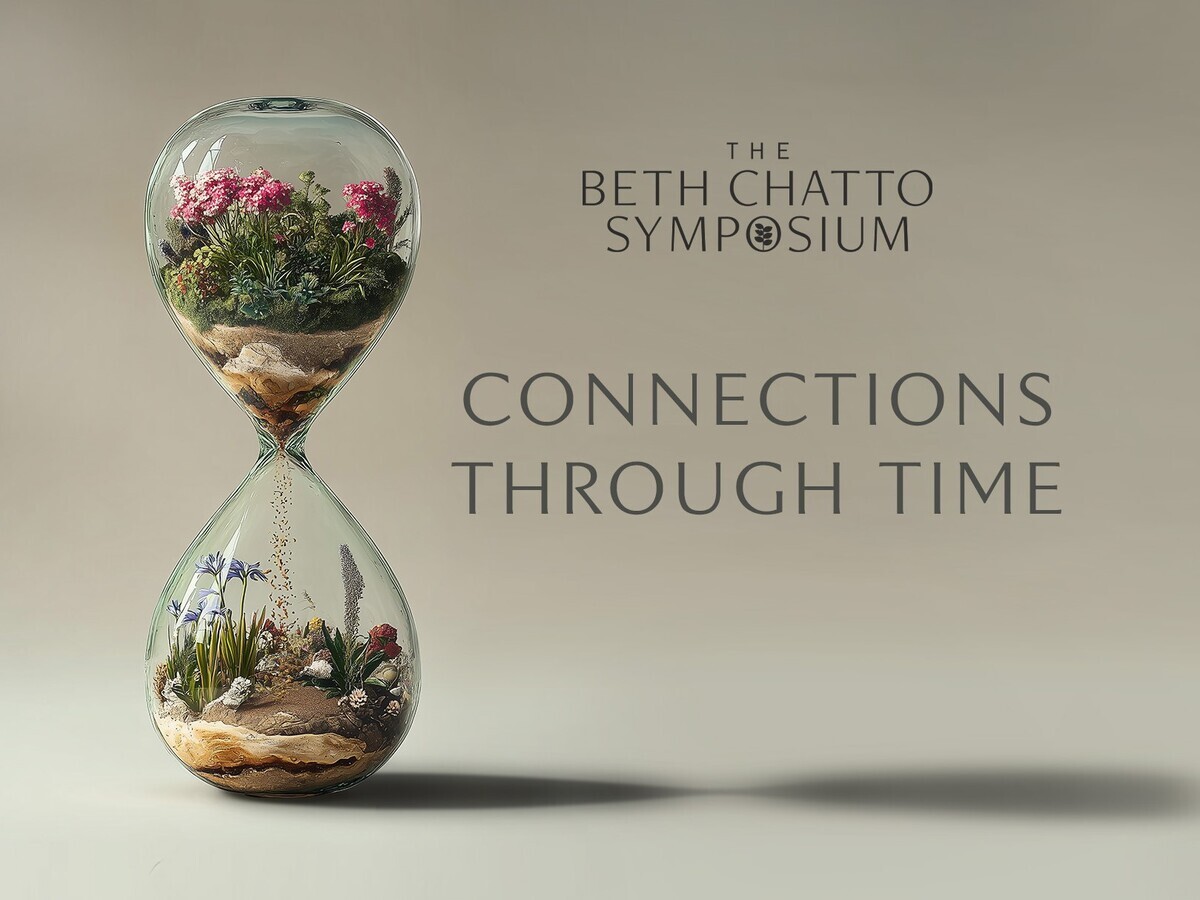
This year’s theme, “Connections Through Time,” invited us to consider the relationships between plants, people and landscapes – and how those relationships are constantly changing. Looking back at what we can learn from the past, the Symposium also asked us to consider the choices we are making today and the kind of future we want to create.
Three days of conversations, ideas and insights are impossible to capture in a brief blog - this is just a small selection of our exceptional speaker lineup - so consider this a flavour of the rich exchange of ideas and perspectives that unfolded over the three days.
We’ll be sharing a series of more comprehensive blogs soon to dive into more details. Stay tuned!
Looking back to move forward
Paleobotanist Jennifer McElwain opened the Symposium with a fascinating journey through millions of years of plant evolution. Her presentation offered a new way of thinking about trees: as living environmental sensors.
Through fossil leaves and other plant remains, scientists can reconstruct clues about the temperatures, atmospheric CO₂ and environmental conditions of the distant past. McElwain’s work demonstrated how plants can act as witnesses to enormous changes in Earth’s climate and atmosphere.
She even collaborated with an artist to recreate the shades of green that fossilised leaves may once have displayed – a beautiful reminder that scientific research can also inspire creativity.
It was a powerful starting point for the Symposium. Trees are not simply features of the landscape; they carry a record of environmental change. Their evolutionary history may also offer clues about how plants could respond to the rapid changes taking place today.
Gardens as ecological networks
Renowned nurseryman Olivier Filippi offered an inspiring perspective from the Mediterranean, where prolonged drought, heatwaves and increasingly severe fires are transforming ecosystems.
Many Mediterranean plants have evolved alongside fire, using underground storage organs known as lignotubers to survive and resprout. But when intense fires are followed by prolonged drought, plants no longer have enough time to recover. Young seedlings can also struggle to survive. The result is a devastating decline in nectar and pollen in the Mediterranean landscape.
Filippi argued passionately that gardens must become more than beautiful spaces for people. They can form part of a much wider ecological network, providing food and habitat for wildlife. His examples also challenged conventional thinking about non-native plants, showing how they’re becoming valuable food resources for insects and birds in a changing climate.
This idea of gardens as places of connection was echoed throughout the Symposium.
In The Future of Urban Nature, Humaira Ikram brought together Benny Hawksbee, Kate Bradbury and Şeniz Mustafa to explore how wildlife is responding to a rapidly changing world.
Giving communities a voice
The human dimension of green space came strongly into focus when Tayshan Hayden-Smith spoke about Grow to Know’s Closing the Green Gap campaign.
Working with young people in North Kensington, the project transforms neglected spaces into community gardens in places that already belong to them – youth clubs, libraries, schools and community spaces.
This is much more than gardening. It challenges questions about who has access to green space, who gets to shape public places and who benefits from them. By involving young people in designing and creating their own green spaces, the project gives communities a genuine voice in shaping the places they call home.
Similarly, Sheila Das, Head of Garden and Parks at the National Trust, explored what it means to bring about change in public and heritage gardens – places that often carry strong traditions and familiar ideas of what a garden should look and feel like.
Ans as we move into a new era of horticulture due to changing climate, we were encouraged to embrace Slow Gardening: taking time to observe before rushing to impose solutions.
Letting plants lead
Kelly D. Norris, in A Gentle Plea for Nuance, encouraged us to look to the prairie as a teacher rather than simply a planting style.
Prairies are dynamic systems shaped by disturbance, competition, abundance, seasonality and resilience. Rather than imposing a fixed plant palette, Norris encouraged us to pay closer attention to the plants that want to grow in a particular place and allow plant communities to interact and evolve.
Landscape designer Dan Pearson revealed his long-term masterplan for the gardens and nursery at Beth Chatto’s. Rather than a rigid blueprint, the plan is intended to guide change while allowing the landscape to evolve over decades.
New land will provide space for meadow, woodland and nursery stockbeds, while a Mediterranean “spine” will connect areas of the existing garden. It is a fitting continuation of Beth Chatto’s philosophy: work with the conditions of a place rather than against them.
Dean Charlton, Ben Preston, Henrietta Huntley, Jonny Bruce and Toby Shaull shared their experiences of running small, independent nurseries, and the vital role they play in maintaining plant diversity, keeping specialist horticultural knowledge alive and encouraging gardeners to discover plants they may otherwise not encounter.
A garden party on Thursday evening gave speakers and attendees a welcomed opportunity to meet, connect and continue conversations in a relaxed setting at the Beth Chatto Gardens.
The second day broadened the idea of connection still further.
Beyond the visible landscape
Writer Elizabeth-Jane Burnett explored the relationship between nature, language, memory and place. Through readings from fiction, non-fiction and poetry, she invited us to follow the threads that weave together time and place.
Barrister extraordinaire Monica Feria-Tinta challenged us to consider whether nature itself should have legal rights, making a compelling argument for giving nature a stronger voice within the legal system. Feria-Tinta’s message was inspiring and ultimately hopeful: the law can help us imagine a different relationship with nature, one in which rivers, forests and other living systems are not simply resources to be used, but worthy of protection in their own right.
Landscape architect Kasey D. Toomey of Terremoto presented the idea of “omni-positive” landscapes – gardens designed to benefit people, ecology, materials and the land, while also questioning how landscape labour is valued.
Microbial ecologist Jake Robinson reminded us that many of the connections within landscapes are invisible. The microbial communities living in soil, plants, air and our own bodies make us participants in nature rather than observers of it.
Darryl Moore’s talkConnections Past, Present and Future explored the many complex connections that bind us to one another and to the world around us – connections that often run far deeper than we realize.
A future shaped by relationships
The Symposium closed with Fergus Garrett, whose warmth and infectious enthusiasm brought together many of the themes explored over the two days. What made the talk so uplifting was Fergus infectious enthusiasm and his belief that gardening is ultimately about relationships – between people and plants, between gardens and the wider landscape, and between generations of gardeners.
The final panel, Gardening for the Future, brought the conversation back to the practical realities of gardening in a changing world. Laura McArthur, Malin Andersson and Shereen Chung Blake, chaired by Lina Liubertaitė, highlighted the importance of flexibility, observation and adaptation.
They also reminded us that the future of gardening is not only about plants. Gardening is physical work, and sustaining the people who care for our landscapes must be part of the conversation too.
And, after two intense days of lectures and debate, there was still time for a garden quiz night at the university bar – a chance to put our plant knowledge to the test and unwind after two packed days of talks and discussions.
Saturday brought everyone back to the garden for a more relaxed finale to the Symposium. Attendees could choose from a programme of talks, tours and hand-on workshops, offering opportunities to explore ideas in a practical way, learn new skills and continue conversations from the previous days. The day featured contributions from Benny Hawksbee, Chris Gibson, Connor Butler, John Little, John Ferguson and researchers from University of Essex, Darryl Moore, David Gates, Ella Uppala, Will Tomson, Stephan Aeschlimann, Fergus Garrett, Shereen Chung Blake, Sheila Das, Owen Hayman, Jac Semmler, Wild City, Kasey Toomey, Peter Korn, Eddie Bailey, Emily Allard, Julia Boulton, Rob Byford, Åsa Greger-Warg & the garden team.
Against the backdrop of the garden, it was a fitting and informal way to bring the Symposium to a close.
Across lectures, panels and workshops, one message emerged again and again: landscapes are not static. They are living systems, continually shaped by climate, people, plants and the countless relationships—both visible and invisible—that connect them.
Perhaps this was the most powerful message of the 2026 Beth Chatto Symposium: the future is not something we simply arrive at. It is something we shape through the relationships we build – with plants, places, people and the wider living world around us.
COMMENTS